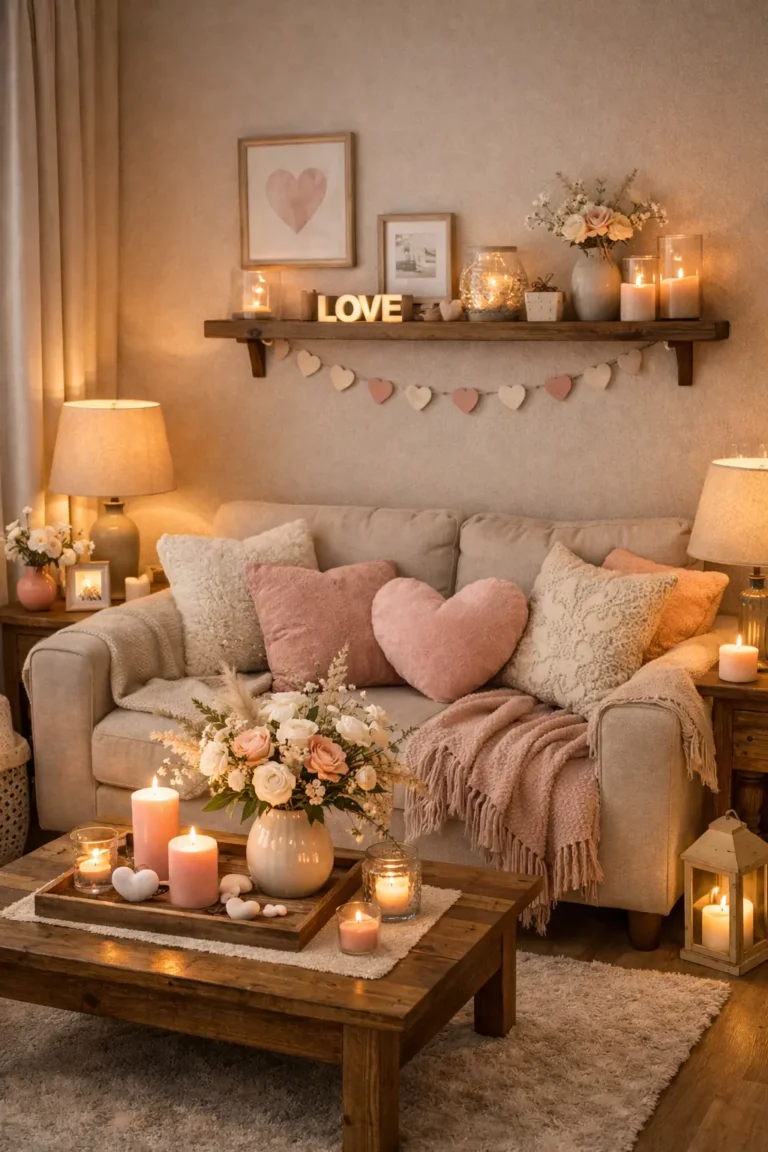

A small apartment living room can feel clean, organized, and still seem unfinished. Maybe the sofa takes up too much space. Perhaps the room feels cold at night. Or the TV dominates one wall while the rest of the room feels disconnected.
The good news is that you usually do not need more furniture or more decorations.
You need a better relationship between space, layout, light, texture, and the things you actually use.
These cozy living room ideas for small apartments are designed around that idea. You will learn how to arrange a small living room, choose furniture that fits, create warmth without clutter, add useful storage, and make the room feel more personal.
The goal is simple:
Make your small living room feel cozy, functional, and inviting without making everyday life harder.
Affiliate Disclosure: This post may contain affiliate links. This means I may earn a small commission at no extra cost to you if you purchase through my links. I only recommend products that align with a cozy, minimalist, and functional home aesthetic.
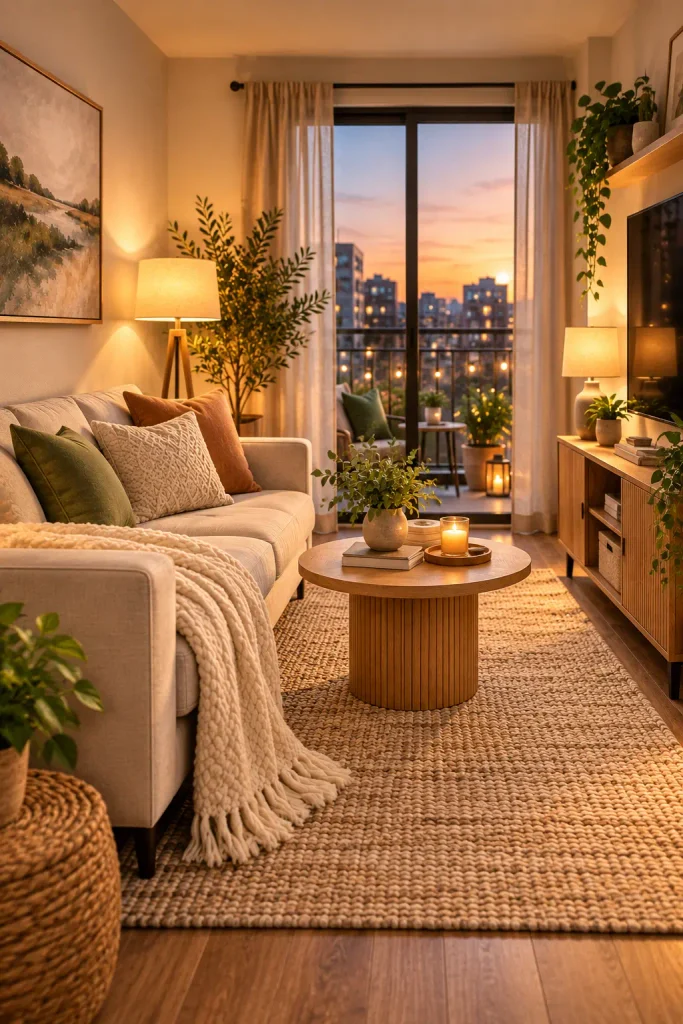
Quick Answer: What Makes a Small Living Room Feel Cozy?
A cozy small living room usually has five things working together:
- Furniture that fits the room instead of overwhelming it
- A layout with clear walking space
- Warm, layered lighting
- Soft textures such as rugs, pillows, and throws
- A limited amount of intentional decor
Most importantly, do not decorate every empty spot.
Leave some breathing room. That empty space helps the furniture, textures, and focal points stand out.
1. Measure Your Living Room Before Buying Anything
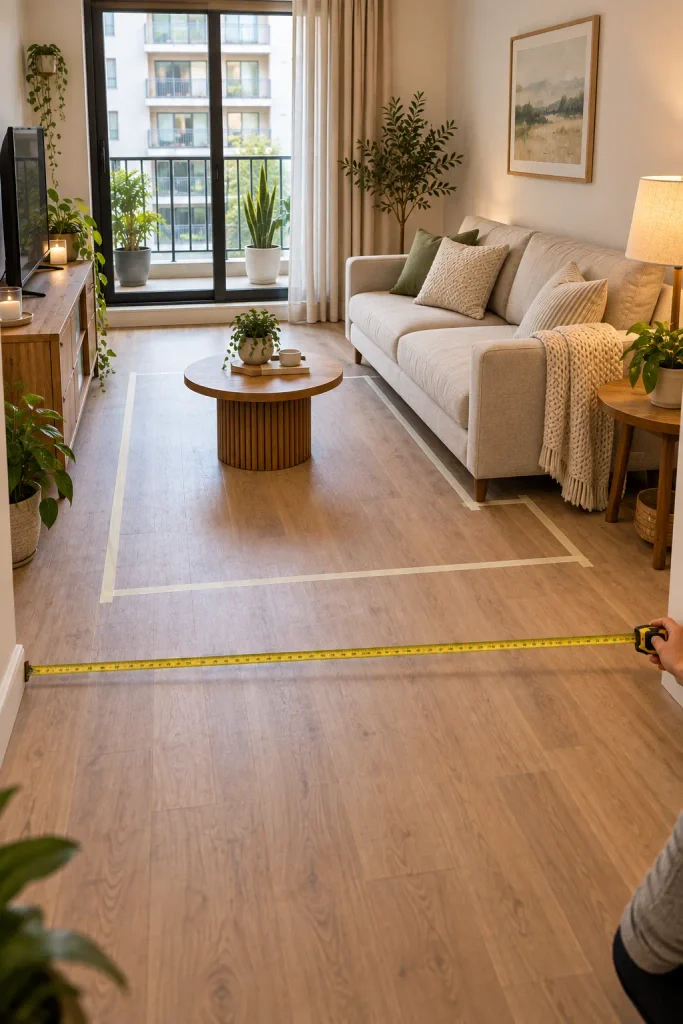
One of the easiest ways to make a small living room feel uncomfortable is to buy furniture first and solve the layout later.
Start with the room itself. Measure the main floor area, then note the location of doors, windows, radiators, and outlets. Next, think about how people naturally move through the space. Even a little empty floor area can make the room feel much more comfortable.
Before you shop, measure:
- Room length
- Room width
- Door openings
- Window positions
- Available wall space
- Walking paths
- Furniture footprint
Then measure the furniture itself.
A product labeled “compact” can still be too deep for your room.
Measure first. Shop second.
That one habit can prevent a surprisingly expensive decorating mistake.
2. Choose Furniture That Fits the Room, Not the Store
Showrooms give furniture plenty of breathing room. A small apartment does not. For that reason, pieces with slimmer arms, lower profiles, and lighter visual weight can often work better.
Furniture that often works well:
- Low-profile sofas
- Slim-arm chairs
- Compact loveseats
- Furniture with visible legs
- Simple silhouettes
- Storage pieces that serve more than one purpose
Pay attention to depth, not just width.
A sofa that is slightly narrower but very deep can still make a room feel cramped.
On the other hand, a properly scaled sofa can leave enough room for a rug, coffee table, lighting, and movement.
What to look for when shopping
Width: Does it fit the wall?
Depth: Does it leave enough room in front?
Height: Does it block windows or sightlines?
Visual weight: Does it look heavy in the room?
The right furniture should make the room feel easier to use.
3. Pick a Layout Before You Decorate
Decor should come after the layout.
Otherwise, you may end up making a beautiful room that is awkward to live in.
Here are four practical small apartment living room layouts to consider.
Layout 1: Sofa Against the Long Wall
Place the sofa along the longest uninterrupted wall.
This can work well when the room is narrow and you need to preserve a clear central path.
Layout 2: TV-Focused Layout
Place the main seating directly toward the TV while keeping the TV console visually light.
This works especially well when the living room is also your main entertainment space.
Layout 3: Conversation Layout
Angle a compact chair or accent seat toward the sofa.
This creates a small conversation zone instead of making the entire room face one screen.
Layout 4: Living + Work Layout
Use one side of the room for the sofa and another small section for a compact desk.
Keep the work area visually simple so the room still feels like a living room first.
The rule to remember
The best layout is the one that lets you move through the room easily while supporting how you actually use it.

or the Seating Area
A rug does more than make the floor feel softer.
It helps visually connect the sofa, coffee table, and chairs into one zone.
Without that connection, furniture can feel like separate objects placed around the room.
Choose the rug after you know your seating layout.
Then consider:
- The size of the seating group
- The room’s proportions
- The rug’s visual weight
- Ease of cleaning
- Thickness under doors and furniture
In a small living room, a rug that is too small can make the whole seating area feel disconnected.
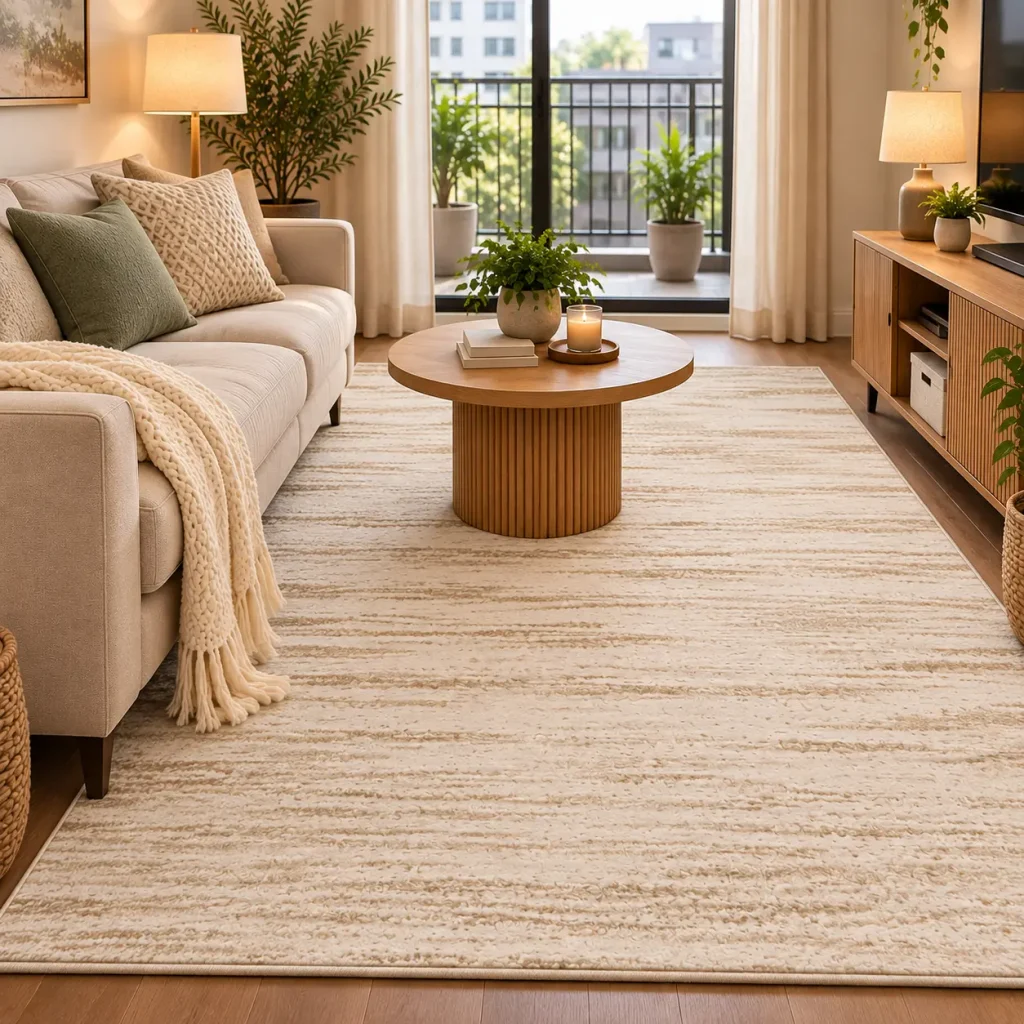
This One Change Can Pull the Whole Room Together
A well-sized rug gives your seating area a clear foundation. This neutral beige design adds cozy texture while blending easily with cream, wood, and muted-green decor.
A simple neutral rug often works well because it adds texture without competing with the rest of the room.

5. Layer Lighting Instead of Relying on One Ceiling Light
If your living room looks fine during the day but feels cold at night, check the lighting before buying more decor.
A single overhead light can illuminate the room, but it may not create the atmosphere you want for relaxing.
Instead, think in three layers.
Ambient lighting
This provides general room illumination.
Task lighting
This supports activities such as reading or working.
Accent lighting
This adds softer pools of light and highlights specific areas.
A simple apartment setup might include:
- One floor lamp
- One table lamp
- Warm-white bulbs
- A small decorative light near the TV or shelf
The goal is not to make every corner glow.
The goal is to give your eyes different levels of light to settle into.
For bulbs, always check the product’s specifications and choose the color temperature that suits how you use the room.

Make the Room Feel Instantly Warmer
A warm table lamp can soften a small living room at night without taking up much space. Place it beside your TV console, shelf, or side table to create a calmer, more inviting glow.
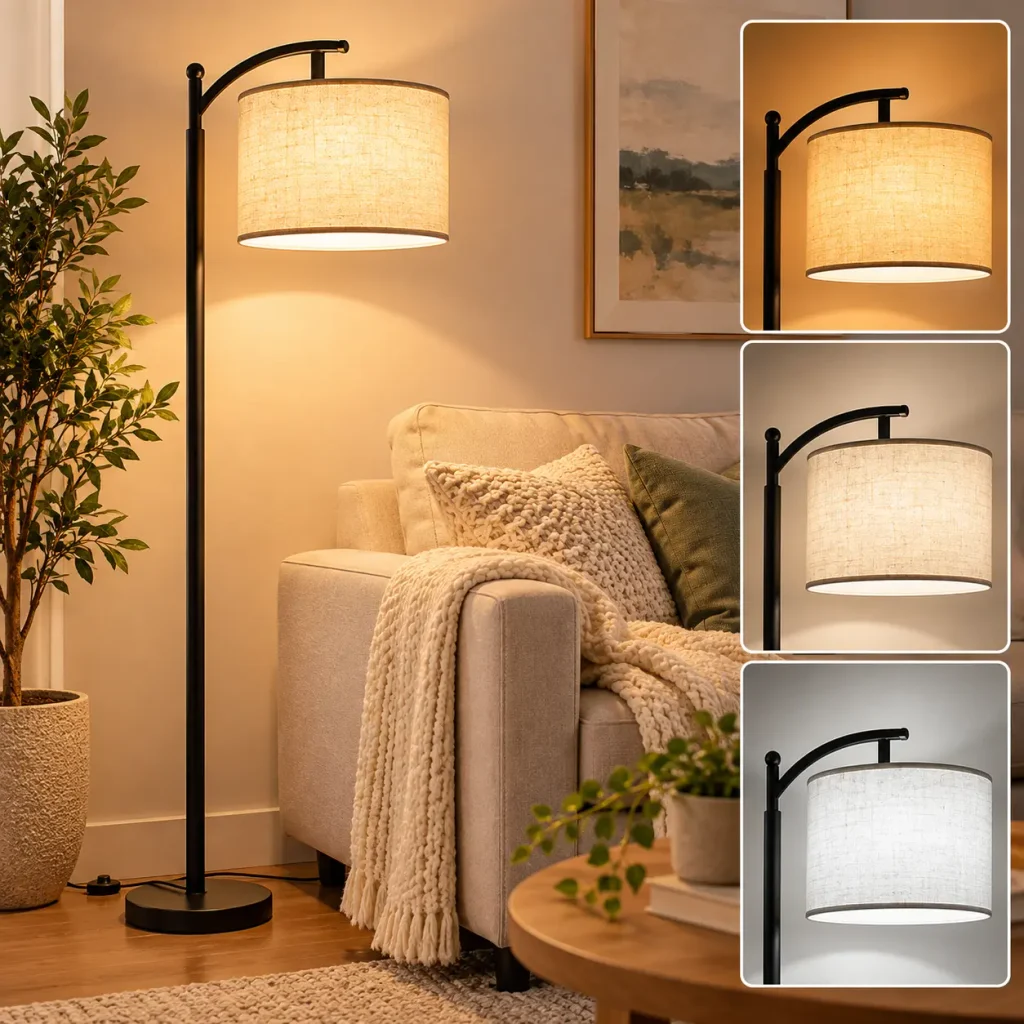
Turn a Cold Corner Into a Cozy One
A slim arched design adds warm, focused light beside a sofa or reading chair without visually overwhelming a small room. The included LED bulb offers 3 color temperatures, so you can switch between a warmer mood, everyday lighting, and cooler task lighting.

6. Add Texture Without Adding Bulk
A room can feel cold even when it has enough furniture.
Usually, what is missing is softness.
Texture gives a room visual depth without requiring another large piece of furniture.
Try combining:
- Knit or woven throws
- Linen or cotton pillow covers
- A textured rug
- Woven baskets
- Natural wood
- Soft curtains
The key is repetition.
You do not need ten different textures.
Choose three or four that work together and repeat them around the room.
For example:
wood + woven texture + soft fabric + greenery
That combination can make a small apartment feel warmer without making it visually busy.
7. Choose One Main Focal Point
Small rooms often feel chaotic when every object is competing for attention.
Choose one area that should attract the eye first.
Your focal point might be:
- The TV wall
- A sofa wall
- A large piece of artwork
- A window
- A reading corner
Then make the other elements support that focal point.
For example, if the TV is the main focus, keep the surrounding shelves simple.
If your artwork is the star, choose quieter furniture and accessories.
This creates something very useful:
visual hierarchy.
The room becomes easier to understand at a glance.

8. Make the TV Corner Part of the Living Room
A TV can easily become the darkest and visually heaviest element in a small apartment.
Instead of treating it like a separate technology zone, connect it to the rest of the room.
Try:
- A slim console
- One small plant
- A little vertical styling
- Warm lighting nearby
- Hidden or organized cables
- A limited number of decorative objects
The goal is not to hide the TV.
It is to make the TV feel like one part of the room instead of the entire room.
For more ideas, see our guide to Cozy TV Corner Ideas for Small Apartments.

Make the TV Wall Feel Complete
A slim TV console gives the room a finished look while creating a place to hide everyday clutter. Choose a piece with useful storage and enough surface space for simple styling without making the living room feel heavy.
9. Add Storage Without Making the Room Look Like Storage
Small rooms need storage.
They just don’t need storage that looks visually heavy.
Choose pieces that blend into the room.
Good examples include:
- Storage ottomans
- Woven baskets
- Narrow cabinets
- Floating shelves
- Storage coffee tables
- Slim media consoles
Use storage for real everyday items:
blankets, remotes, books, cables, games, chargers, and other things that normally end up on visible surfaces.
When everything has a home, the room feels calmer because you spend less time looking at unfinished little piles.

Add Comfort Without Losing Space
A storage ottoman can do more than add a place to rest your feet. Use it as extra seating, a soft coffee-table alternative, or a discreet spot to store throws and everyday clutter. Choose a size that leaves a clear path around the seating area.
10. Choose Furniture That Does More Than One Job
This is one of the smartest approaches for a small apartment.
When possible, choose an item that solves two problems.
For example:
Storage ottoman
→ seating + storage
Lift-top coffee table
→ table + temporary work/dining surface
Nesting tables
→ everyday side tables + extra surface when guests arrive
Compact desk
→ work area + occasional console
Sofa bed
→ everyday seating + guest sleeping space
Before buying multifunctional furniture, think about how often you will actually use the second function.
A clever product is only useful if the second feature solves a real problem.
11. Use Walls and Vertical Space
When floor space is limited, look upward.
Walls can hold visual interest without taking up valuable walking space.
Try:
- One larger artwork
- A mirror
- A short floating shelf
- A vertical gallery arrangement
- Lightweight greenery
- A narrow wall-mounted display
However, do not fill every inch.
A small room still needs visual breathing room.
One larger piece often creates a calmer result than many tiny objects scattered across the wall.
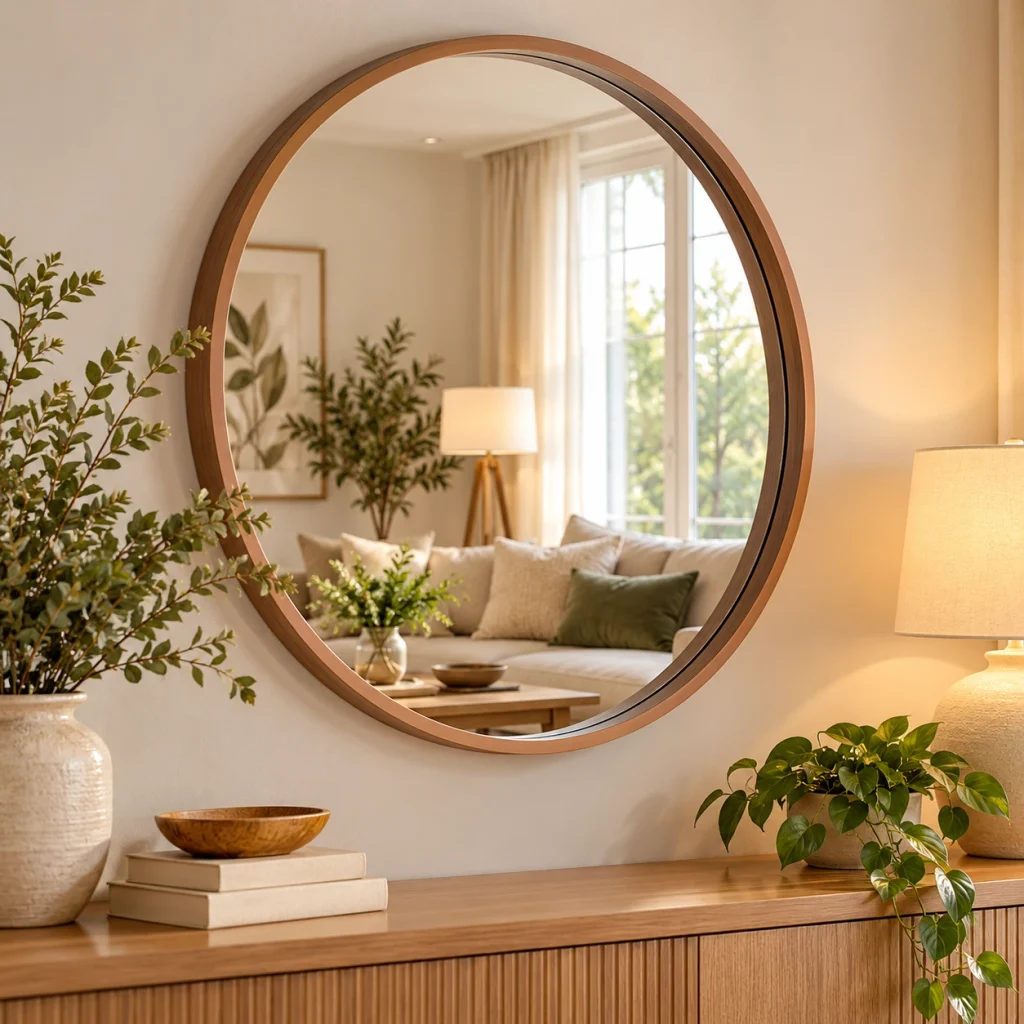
A Round Mirror That Opens Up a Small Room
The rounded shape softens the room while the reflective surface adds light and visual depth. A simple choice for making a compact living room feel brighter and more spacious.
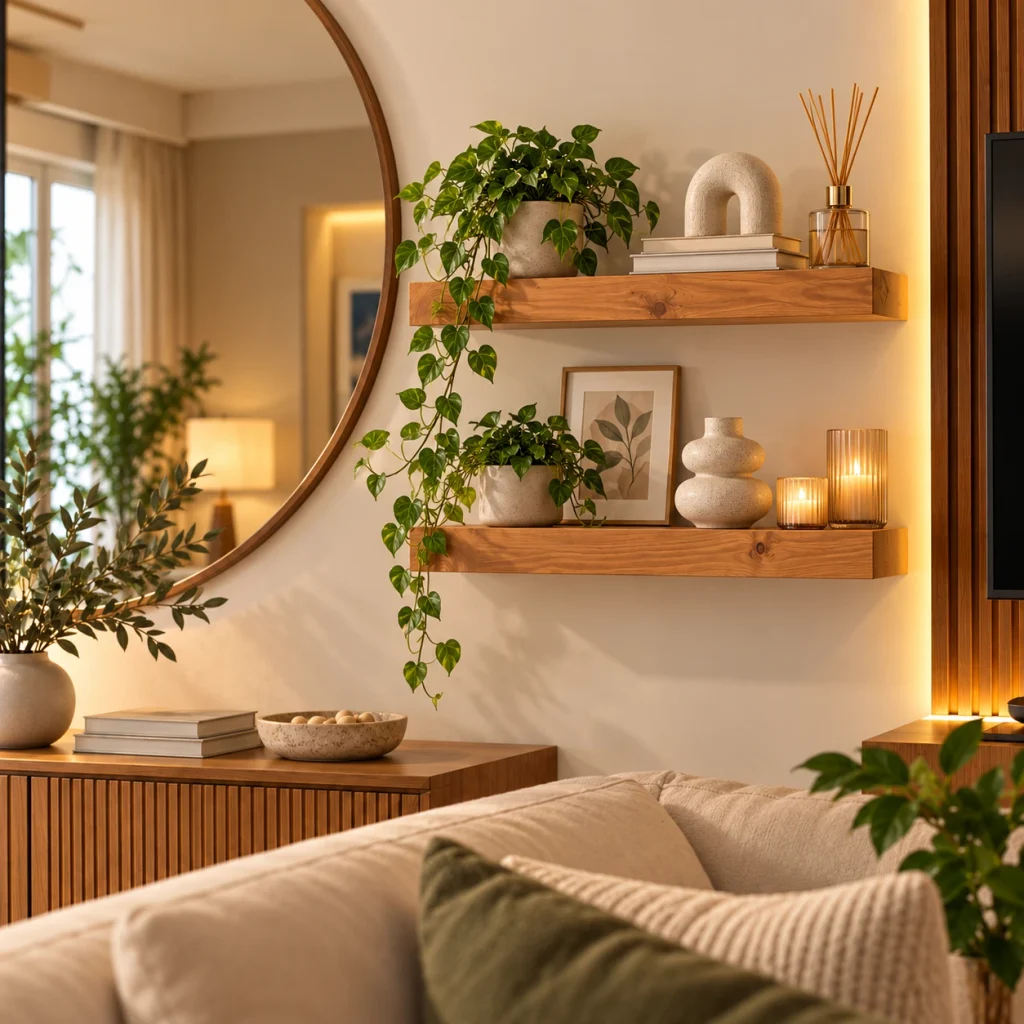
The Shelf That Makes Empty Walls Feel Finished
Add useful display space without taking up floor space. A warm wood floating shelf can frame your favorite books, plants, and small decor while keeping the room visually light.

A mirror can add visual depth while also serving a practical purpose.
Place one where it makes sense for the room rather than simply putting a mirror on the largest empty wall.
Windows can also help the room feel brighter.
Keep the surrounding area visually light when possible.
Avoid blocking the window with oversized furniture or heavy decorative pieces.
The goal is simple:
Keep light and sightlines moving through the room.
12. Use Mirrors and Windows to Keep the Room Feeling Open
A mirror can add visual depth while also giving the room another useful focal point. In a small living room, place one where it can reflect natural light, a pleasant view, or another attractive part of the space.
Rather than automatically choosing the largest empty wall, think about what the mirror will reflect. A mirror facing clutter can simply make the room look twice as busy.
Windows can help create the same feeling of openness. Keep the area around them visually light so natural light can move through the room without being blocked by oversized furniture or heavy decor.
A simple approach:
- Choose a mirror that suits the scale of the room.
- Place it where the reflection adds something useful.
- Keep window areas relatively clear.
- Use light or softly textured curtains when privacy is needed.
- Avoid covering too much of the glass with decorative items.
The goal is not to make the room look bigger through tricks. It is to keep light, reflections, and sightlines moving through the space.

13. Add Plants Without Losing Floor Space
Plants can add softness and life to a room.
In a small apartment, however, several floor plants can quickly consume valuable space.
Instead, consider using height.
Try:
- One taller plant in an unused corner
- A small plant on a shelf
- A trailing plant on a suitable high surface
- One compact tabletop plant
You don’t need a jungle.
One or two well-placed plants can be enough to soften the harder lines of furniture and electronics.
14. Build a Warm, Cohesive Color Palette
A small apartment often feels calmer when the colors work together.
Start with a simple base:
cream + beige + warm wood
Then add one or two supporting colors such as:
soft green
muted brown
warm gray
subtle burgundy
You do not have to follow a strict rule.
Instead, repeat colors intentionally.
For example:
- cream sofa
- warm wood table
- muted green plant
- beige rug
- brown woven basket
Now the room feels connected.
The goal is not to remove personality.
It is to avoid making every object fight for attention.

15. Make the Living Room Renter-Friendly
Renters often have a specific decorating problem:
You want the room to feel personal, but you do not want to risk your deposit.
Start with solutions that do not require permanent changes.
Try:
- Leaning artwork
- Freestanding shelves
- Rugs
- Lamps
- Pillows
- Throws
- Plants
- Furniture-based styling
- Suitable removable hanging products
For any adhesive or removable product, check the manufacturer’s instructions, weight limits, surface requirements, installation method, and removal instructions.
Do not assume that every removable product is suitable for every wall.
When there is uncertainty, use a furniture-based solution.
16. Make a Small Living Room Look Bigger Without Removing Its Personality
A room can feel larger without actually becoming larger.
Start by improving what your eye sees.
Use clear sightlines
Avoid putting large objects directly into the main visual path.
Keep furniture proportional
An oversized sofa can make the entire room feel smaller.
Let some floor remain visible
Too many bulky pieces can visually close the space.
Use vertical elements
Tall curtains, narrow shelves, and vertical artwork can draw the eye upward.
Keep surfaces under control
Clutter makes a room visually harder to read.
Repeat materials
When several objects share a similar color or material, the room feels more cohesive.
The goal is not to make your apartment look empty.
It is to make it feel intentional rather than crowded.
17. Create a Cozy Living Room on a Budget
You don’t have to replace everything.
In fact, a full-room shopping spree is often the fastest way to create more clutter.
Start with the change that will make the biggest difference.
Under $25
Try:
- Pillow covers
- Small greenery
- Decorative tray
- Warm light accessory
Under $50
Consider:
- A better lamp
- Woven basket
- Small artwork
- Additional textiles
Under $100
You may be able to create a more noticeable change through:
- A larger rug
- Better layered lighting
- A storage piece
Bigger upgrades
Save these for later:
- Sofa
- TV console
- Coffee table
- Larger storage furniture
Decorating tip: solve the biggest problem first.
If your room is too dark, buy lighting before buying another vase.
If your room has no storage, buy storage before buying more decor.
That keeps your budget focused.

18. If Your Apartment Is a Studio, Create Visual Zones
Studio apartments need a slightly different approach.
The living room may share space with the kitchen, bedroom, workspace, or dining area.
Instead of building physical walls, use visual boundaries.
You can create zones with:
- A rug
- Sofa placement
- Lighting
- A narrow shelf
- A small side table
- Different but coordinated textures
For example:
Rug = living zone
Desk = work zone
Bed = sleep zone
The apartment remains open, but each area has a purpose.
19. If Your Living Room Also Works as a Home Office
This is increasingly common in small apartments.
The challenge is not just fitting a desk.
It is making sure the room can still feel relaxing after the laptop closes.
Try creating a visual separation between work and rest.
During work
Use:
- Desk lamp
- Compact desk
- Task chair
- Simple wall background
After work
Clear the desk where possible.
Turn on softer lighting.
Move the chair back.
Let the living room visually return to its main purpose.
For more detailed ideas, see Cozy Home Office Ideas for Small Spaces.
20. Give the Room One Personal Detail
A cozy room should not look like a showroom.
You need one or two details that tell people someone actually lives here.
It might be:
- A favorite book
- Framed travel photo
- Handmade object
- Vintage side table
- Art you genuinely like
- A meaningful plant
- A family piece
This matters because a room can be technically “perfect” and still feel emotionally empty.
Do not copy a complete room from Pinterest.
Instead, take the parts that work for you and make the room your own.
A Simple Small Apartment Living Room Makeover Formula
When you feel overwhelmed, use this order:
Step 1 — Clear the room
Remove anything you do not use or love.
Step 2 — Fix the layout
Make the walking path easier.
Step 3 — Check furniture scale
Remove or replace anything that overwhelms the room.
Step 4 — Add the rug
Use it to define the seating zone.
Step 5 — Layer the lighting
Add soft light where the room needs warmth.
Step 6 — Add texture
Use pillows, throws, rugs, baskets, and natural materials.
Step 7 — Add storage
Give everyday clutter a home.
Step 8 — Style the walls
Add one strong visual feature.
Step 9 — Add greenery
Use height without filling the floor.
Step 10 — Add personality
Finish with one or two meaningful details.
This order matters because decor works better after the room already functions well.

7 Small Living Room Mistakes to Avoid
1. Buying furniture before measuring
Measure first.
2. Choosing the biggest sofa that fits
“Fits” and “fits comfortably” are not the same thing.
3. Using a tiny rug
The seating area can feel disconnected.
4. Relying on one harsh overhead light
Layer your lighting instead.
5. Decorating every empty surface
Empty space is useful.
6. Buying storage without considering appearance
Storage should solve clutter without creating more visual weight.
7. Buying decor before solving the main problem
Extra pillows will not fix a bad layout.
Likewise, baskets cannot solve a lighting problem.
And adding artwork will not make oversized furniture fit the room.
Solve the room’s biggest problem first.
How to Choose What to Buy First
Before adding an Amazon product to your cart, ask three questions:
1. What problem does this solve?
If you cannot answer that, wait.
2. Where will it go?
Measure the actual space.
3. Where will it live when you change the room later?
This is especially important in a small apartment.
A useful piece should work in your current setup and still have a reasonable place in your next one.
Want to Recreate This Cozy Living Room Look?
Shop the Cozy Small Apartment Living Room
Foundation
- Compact sofa
- Neutral area rug
- Small coffee table
Warmth
- Floor lamp
- Table lamp
- Textured throw
- Pillow covers
Function
- Storage ottoman
- Woven basket
- Slim TV console
- Floating shelf
Finishing touches
- Mirror
- Simple artwork
- Compact plant
Three Easy Cozy Living Room Setups
Setup 1: The Minimal Cozy Living Room
Best for very small spaces.
Use:
Compact sofa + rug + floor lamp + small table + one plant
The result is simple and easy to maintain.
Setup 2: The TV-Centered Cozy Living Room
Best for movie and streaming lovers.
Use:
Compact sofa + slim TV console + rug + warm lamp + soft textiles + one storage basket
Keep the TV area visually clean.
Setup 3: The Cozy Living + Work Room
Best for remote workers.
Use:
Compact sofa + rug + desk + task light + floor lamp + small storage
Keep work accessories contained so the room can switch back to relaxation mode.
Final Thoughts
The best cozy living room ideas for small apartments are not about squeezing more things into less space.
They are about making better decisions with the space you already have.
Measure before buying.
Choose furniture that fits.
Protect your walking paths.
Use a rug to anchor the room.
Layer your lighting.
Add texture without adding bulk.
Give everyday items a home.
Then add the decorative details that make the room feel like yours.
And remember one simple rule:
Solve the room’s biggest problem before buying another decoration.
That is how a small living room becomes not only beautiful, but genuinely comfortable to live in.
Frequently Asked Questions About Cozy Living Rooms in Small Apartments
Start with the layout and furniture scale before adding more decor. Choose furniture that fits the room, create a clear walking path, add a rug to anchor the seating area, layer warm lighting, and introduce soft textures such as pillows and throws. A limited color palette and a few intentional decorative pieces can make the room feel cozy without creating clutter.
Compact sofas, slim-arm chairs, low-profile furniture, nesting tables, storage ottomans, and narrow TV consoles can work well in small apartment living rooms. Pay attention to both width and depth before buying, because a piece that fits one measurement can still overwhelm the room when it is too deep or visually heavy.
Start with the largest piece, usually the sofa, and arrange the rest of the furniture around how you actually use the room. Keep a comfortable walking path, position the seating toward the main focal point, and use the rug and coffee table to connect the seating area. In a studio apartment, rugs and furniture placement can also help define separate living and work zones.
Keep clear sightlines, avoid oversized furniture, leave some visible floor space, and control visual clutter. Vertical artwork, mirrors, lighter window treatments, cohesive colors, and furniture with a lighter visual footprint can also help the room feel more open without removing its personality.
A rug can help anchor the sofa, coffee table, and other seating into one visually connected zone. Choose the rug after deciding on your furniture arrangement, and measure the available space before buying. Avoid choosing a rug solely because it looks good online; its proportions should work with the seating area and room.
Layered lighting usually creates a more comfortable atmosphere than relying on one ceiling light. Combine general ambient lighting with task lighting for reading or working and softer accent lighting for atmosphere. A floor lamp, table lamp, and warm decorative light can add depth while using very little floor space.
Choose storage that blends with the room and solves an everyday problem. Storage ottomans, woven baskets, narrow cabinets, floating shelves, storage coffee tables, and slim media consoles can help contain blankets, books, remotes, cables, and other items. The goal is to give everyday clutter a home without adding unnecessary visual weight.
Use rugs, lamps, plants, pillows, throws, leaning artwork, freestanding shelves, and furniture-based styling to add warmth without permanent changes. When using removable hanging products, always check the manufacturer’s instructions, weight limits, surface requirements, and removal guidance before installation.
Warm neutrals such as cream, beige, warm white, natural wood, soft green, muted brown, and warm gray can create a calm foundation. You can add personality with one or two accent colors rather than using many competing shades. Repeating the same colors across the rug, pillows, artwork, and accessories can also make the room feel more cohesive.
Start with the room’s biggest problem instead of buying lots of new decor. A lamp can improve a dark room, pillow covers can refresh a sofa, and a woven basket can solve visible clutter. Focus your budget on a few useful pieces and reuse furniture and accessories you already own whenever possible.
Treat the TV as part of the overall living-room design rather than the only focal point. A slim TV console, organized cables, simple styling, warm lighting, and balanced furniture can help the TV area feel less visually heavy. Avoid filling the entire wall with decor, especially when the TV already has strong visual weight.
One of the most common mistakes is buying too much before solving the layout. Oversized furniture, a poorly scaled rug, blocked walking paths, harsh lighting, and too many small decorative objects can make the room feel crowded. Measure first, solve the main functional problem, and add decor gradually.