

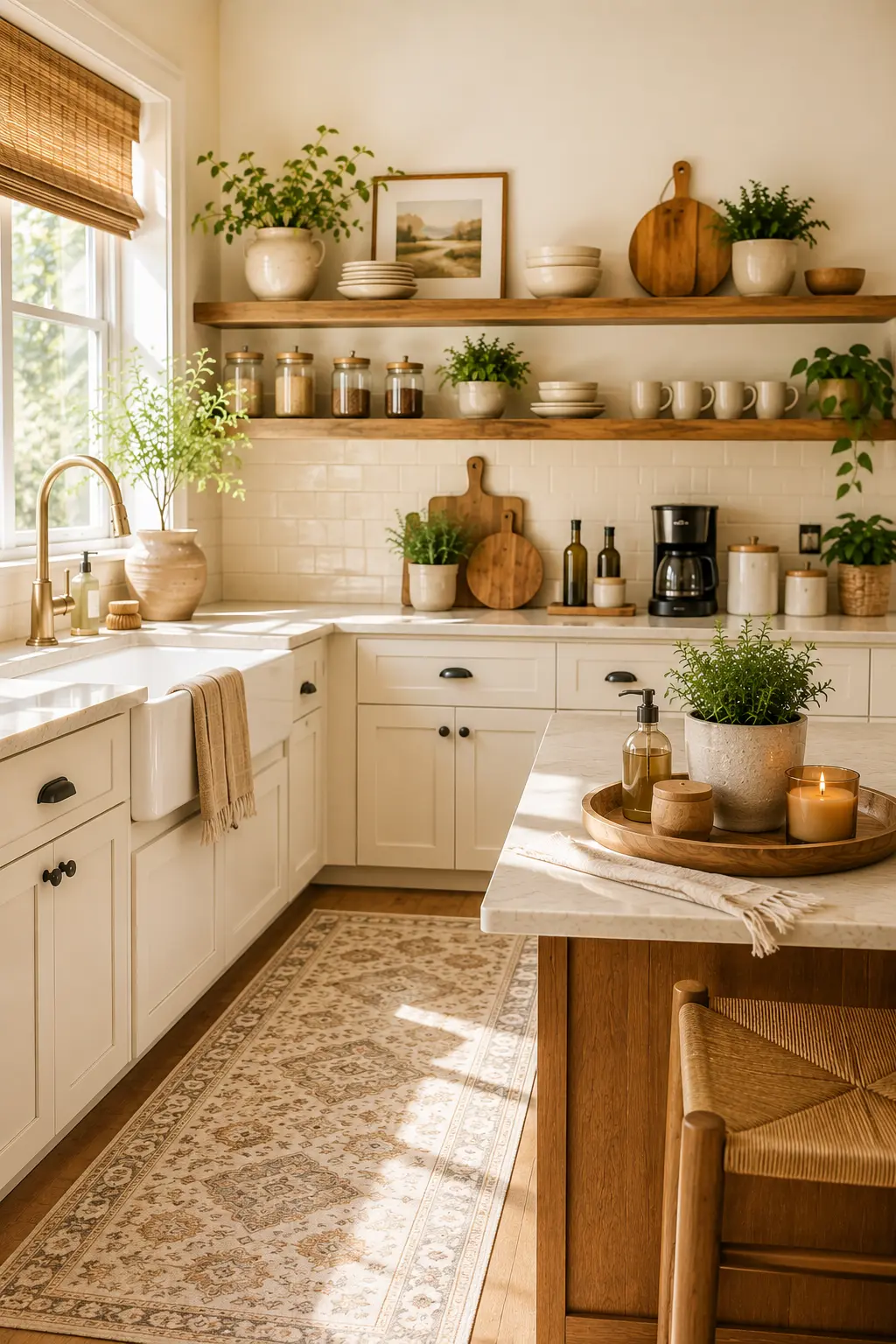
Your kitchen doesn’t need a complete renovation to feel warm, comfortable, and inviting.
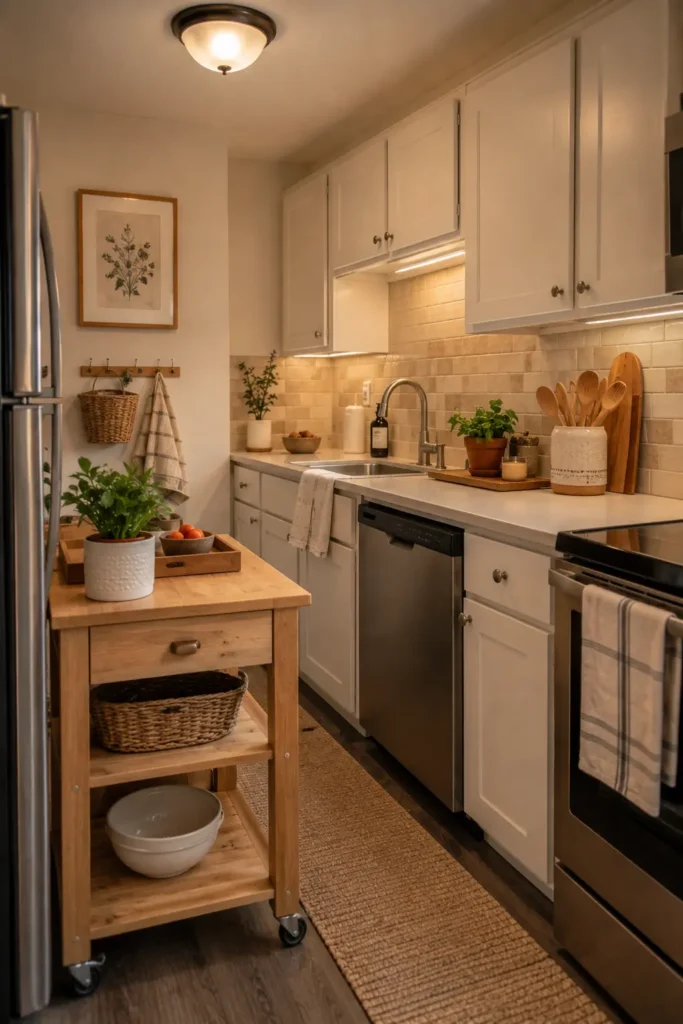
Sometimes the biggest difference comes from smaller changes: warmer lighting, natural wood, a soft runner, a few meaningful objects, some greenery, or simply clearing enough counter space for the room to breathe.
The best cozy kitchen ideas aren’t about filling every empty surface with decor. They’re about creating a balance between warmth, texture, light, function, and personality so your kitchen feels like a place where you actually want to spend time.
And that can look different depending on your home. A large family kitchen might need comfortable seating and better lighting, while a small apartment kitchen may benefit more from vertical storage and carefully edited countertops. If you’re renting, you can still create plenty of warmth without making permanent changes.
In this guide, we’ll look at practical ways to make a kitchen feel cozy without losing the functionality that makes it useful in the first place.
Affiliate Disclosure: This post may contain affiliate links. This means I may earn a small commission at no extra cost to you if you purchase through my links. I only recommend products that align with a cozy, minimalist, and functional home aesthetic.
Start With Your Kitchen Before You Start Shopping
Before buying anything, take a few minutes to look at your kitchen as it is.
Ask yourself:
- What part of the kitchen feels cold or uninviting?
- Is the lighting too bright or harsh?
- Are the countertops cluttered?
- Does the room feel visually empty?
- Are there too many unrelated decorative objects?
- Is there enough warmth from wood, textiles, or other natural materials?
- How do you actually use the kitchen every day?
This step sounds simple, but it can prevent you from buying things that don’t solve the real problem.
For example, if your kitchen already has plenty of decorative objects but feels cold at night, another vase probably won’t help. Better lighting might.
If the kitchen feels visually hard because it contains mostly cabinets, stone, metal, and tile, a wood cutting board, woven basket, runner, or soft textile may make a bigger difference.
And if the kitchen feels chaotic because everything is competing for counter space, adding more decor will only make the problem worse.
Start with the feeling you want to change, then choose the smallest number of changes that can create that feeling.
That is the easiest way to create a cozy kitchen without turning decorating into clutter.
What Makes a Kitchen Feel Cozy?
These same principles are useful throughout the home, and you can explore more cozy home decor ideas if you want to carry the feeling into other rooms.
Think of it as six layers:
Warmth
Warm whites, creams, earthy neutrals, natural wood, and muted colors can make a kitchen feel softer than a room dominated by cool whites and gray.
Texture
Runners, linen towels, woven baskets, ceramics, wood, and upholstered seating help break up the hard surfaces that naturally dominate a kitchen.
Light
A kitchen needs good task lighting for cooking, but cozy kitchens also benefit from warmer ambient and accent lighting.
Natural materials
Wood, stone, woven fibers, ceramic, and greenery add visual depth and keep a neutral kitchen from feeling flat.
Function
A cozy kitchen still needs to work. Clear preparation areas, useful storage, comfortable seating, and sensible traffic flow matter just as much as decoration.
Personality
Artwork, cookbooks, vintage pieces, favorite ceramics, plants, or objects with a story make a kitchen feel lived in rather than staged.
The goal isn’t to maximize all six.
It’s to find the right balance for your space.
Cozy doesn’t mean cluttered.
A kitchen can have personality and warmth while still having plenty of visual breathing room.
Start With a Warm Kitchen Color Palette
One of the easiest ways to make a kitchen feel warmer is to soften the color palette.
That doesn’t mean everything needs to be beige.
Warm white, cream, taupe, soft beige, muted sage, natural wood, and other earthy tones can work beautifully together. Even a mostly white kitchen can feel inviting when warmer materials and colors are introduced through smaller details.
Try a simple base-and-accent approach
Start with one dominant neutral, then introduce one or two supporting tones.
For example:
Warm white + natural oak + muted sage
or
Cream + beige + warm brown
or
Soft white + walnut + muted terracotta
This prevents the kitchen from becoming visually noisy.
If your cabinets are already white, you don’t necessarily need to repaint them. Instead, introduce warmth through:
- wooden cutting boards
- a neutral runner
- woven baskets
- warm lighting
- ceramic pieces
- greenery
- artwork
- natural textiles
This approach is especially useful if you’re renting or simply don’t want to undertake a major project.
Don’t chase trends too closely
Warm earthy tones are popular in current kitchen design, but you don’t need to redesign your kitchen every time color trends change.
Choose colors you genuinely enjoy and use trendier shades as small accents rather than making them the foundation of the room.
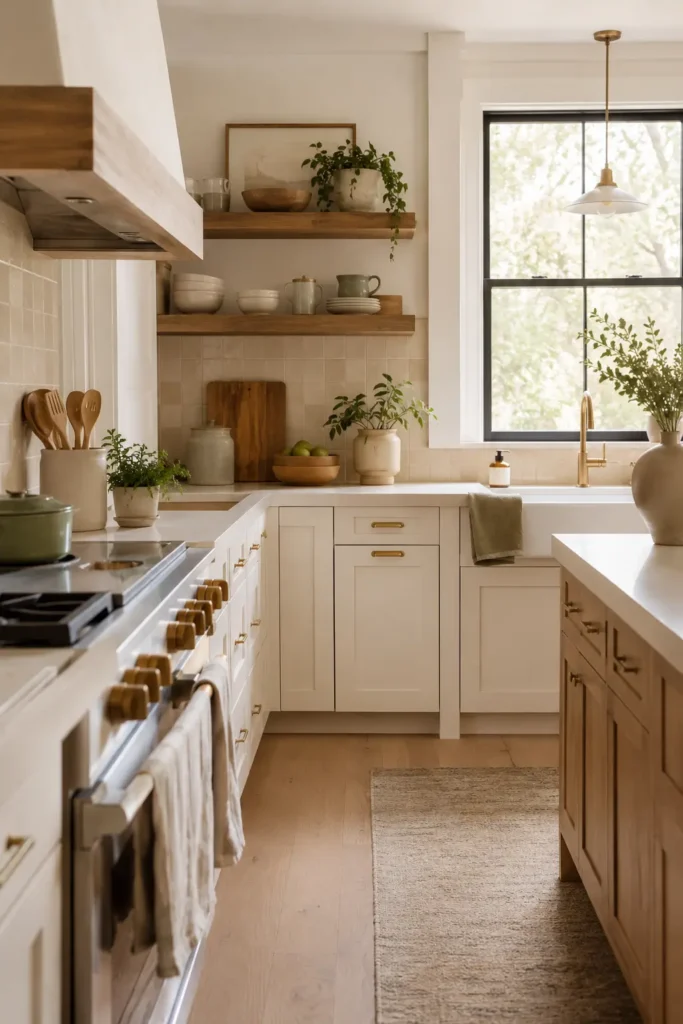
Layer Your Kitchen Lighting
Lighting may be one of the most effective ways to change how a kitchen feels.
A kitchen can look beautiful during the day and surprisingly cold at night if it relies entirely on one bright overhead fixture.
Instead, think in layers.
Ambient lighting
This provides general illumination for the room.
Examples include:
- ceiling fixtures
- recessed lighting
- pendant lights
- natural daylight
Task lighting
This helps you see what you’re doing.
Examples include:
- under-cabinet lighting
- countertop lighting
- brighter lighting around food-preparation areas
Accent lighting
This is what helps create atmosphere.
Examples include:
- decorative lamps
- warm pendant lighting
- small lights on shelves
- subtle lighting around display areas
The goal is to make it possible for your kitchen to transition from bright and functional while cooking to soft and welcoming when you’re relaxing or having coffee.
For a particularly cozy atmosphere, warmer light sources are generally more inviting than very cool, blue-toned lighting.
If you rent, rechargeable or removable under-cabinet lighting can be especially useful because you can improve the atmosphere without rewiring the kitchen.
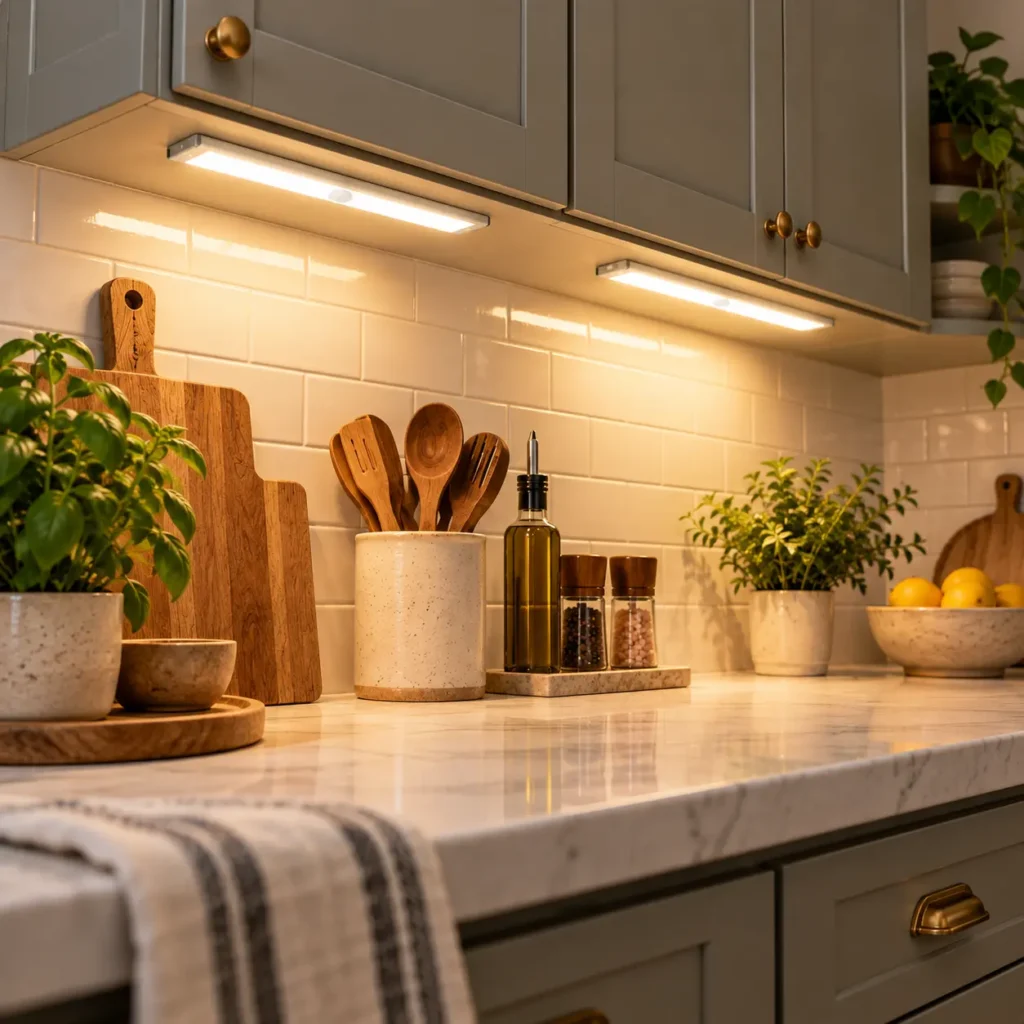
MCGOR 14.7″ Rechargeable Under-Cabinet Lights — 2 Pack
Rechargeable under-cabinet lights with magnetic mounting, motion sensing, and dimming controls. They can add a practical layer of light beneath kitchen cabinets without requiring permanent wiring.
Shopping idea: Look for a slim, rechargeable, warm-white under-cabinet light with a magnetic or removable mounting system.
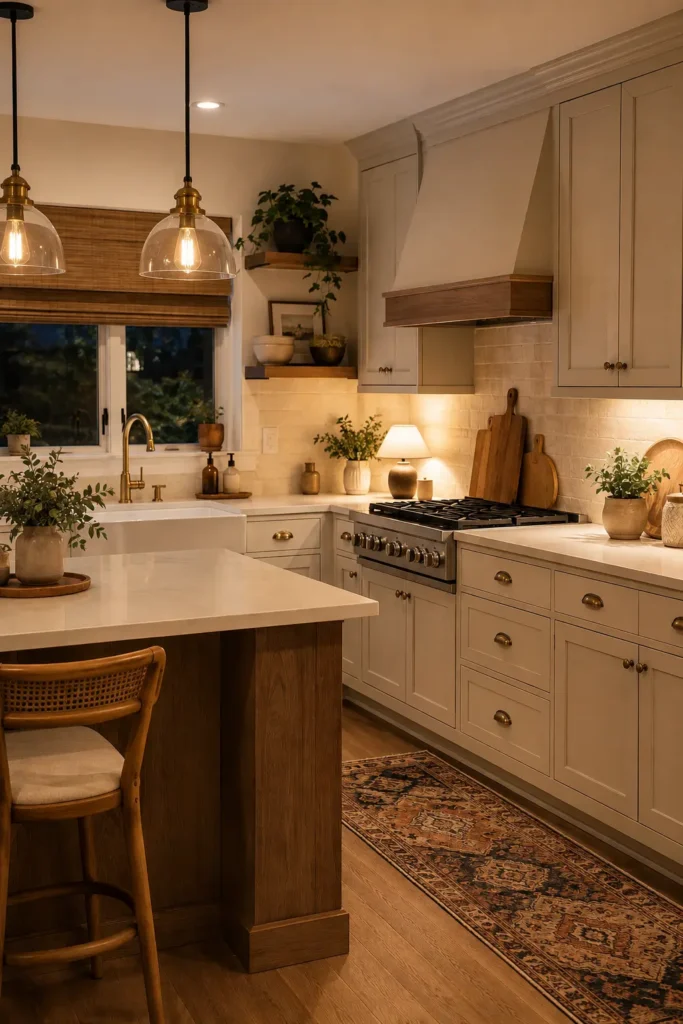
Add Natural Wood for Instant Warmth
Kitchens naturally contain many hard surfaces: cabinets, countertops, appliances, tile, glass, and metal.
Natural wood helps soften that visual hardness.
You don’t need wooden cabinets to get the effect.
Try smaller pieces such as:
- a large wooden cutting board
- a serving board
- wooden stools
- a countertop tray
- open wood shelving
- a simple wooden utensil holder
- a small wood-framed piece of artwork
One simple way to use wood is to lean a beautiful cutting board against the backsplash when it isn’t being used.
It adds warmth while still being functional.
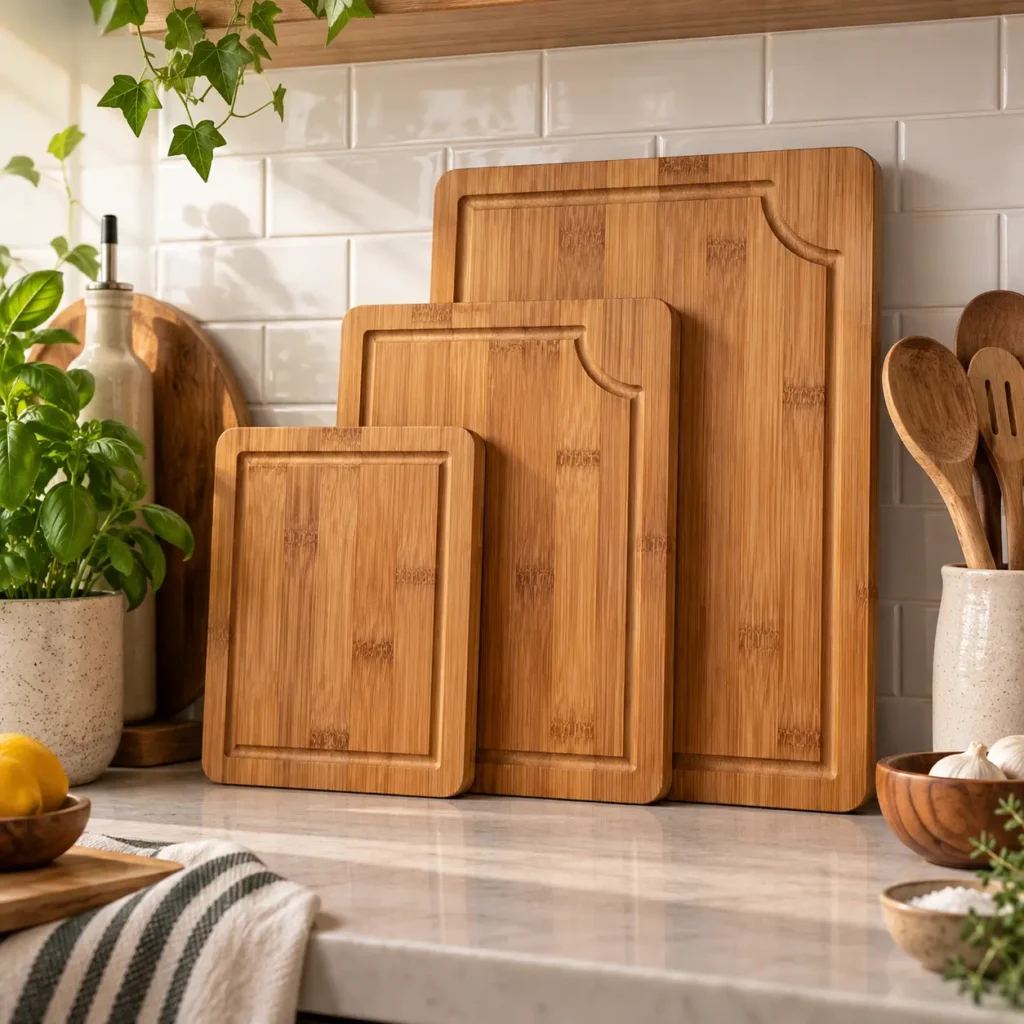
ROYAL CRAFT WOOD 3-Piece Bamboo Cutting Board Set
A three-piece bamboo cutting board set in different sizes, with built-in juice grooves and handles. The natural wood finish adds warmth and texture while giving you versatile boards for everyday food preparation and serving.
Mix wood carefully
You don’t have to match every wood tone perfectly.
In fact, slightly different natural wood tones can make a kitchen feel more collected and relaxed.
Just avoid introducing too many competing finishes.
If you already have light oak cabinets, for example, you might use a medium-toned wood accessory rather than adding several dramatically different dark woods.
The goal is natural variation, not visual competition.
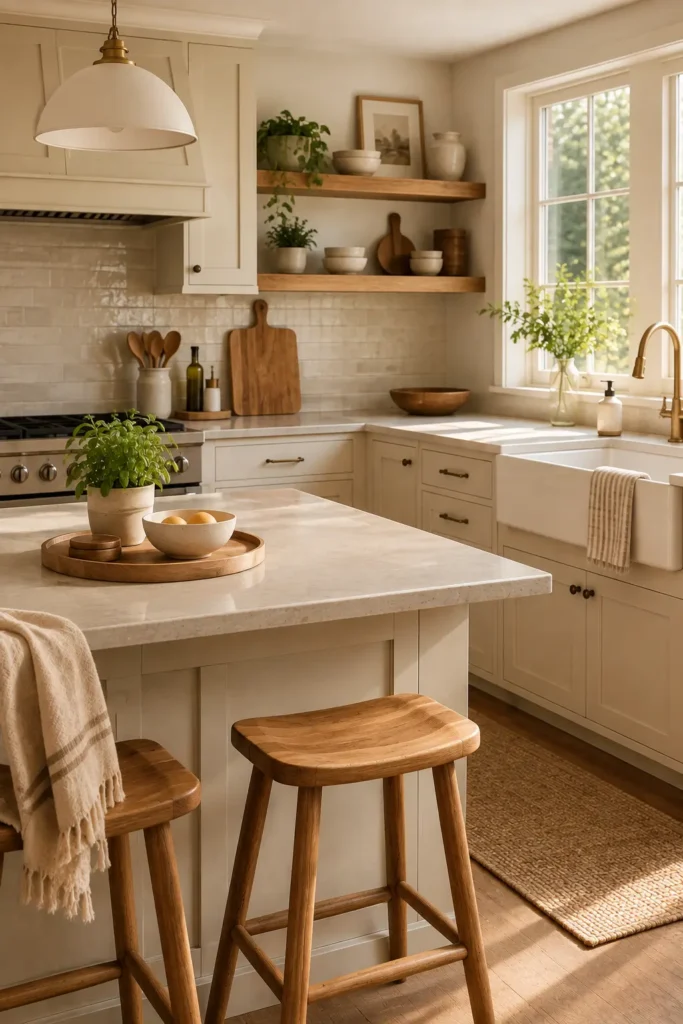
Soften the Floor With a Kitchen Runner
A kitchen runner can make an immediate difference because it introduces softness into a room dominated by hard flooring and cabinetry.
It can also visually define the main working zone.
Look for a runner that is:
- washable
- low pile
- easy to clean
- appropriately sized
- comfortable underfoot
- secure enough for the space
- neutral or softly patterned
A subtle pattern is often more forgiving than a completely solid light rug, especially in a high-traffic kitchen.
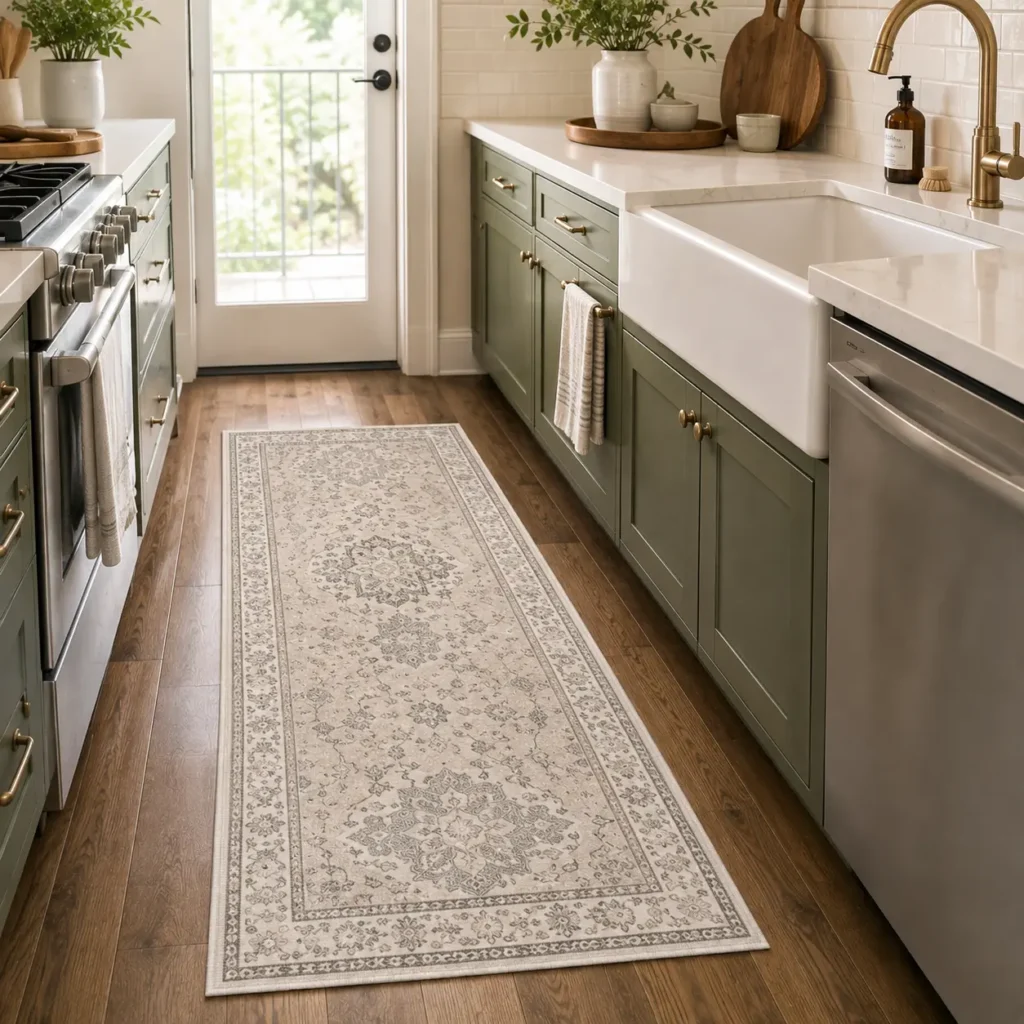
2×6 Washable Vintage Kitchen Runner Rug
A neutral vintage-inspired runner that can add warmth and softness to a kitchen walkway. The washable design and non-slip backing make this style practical for everyday kitchen use.
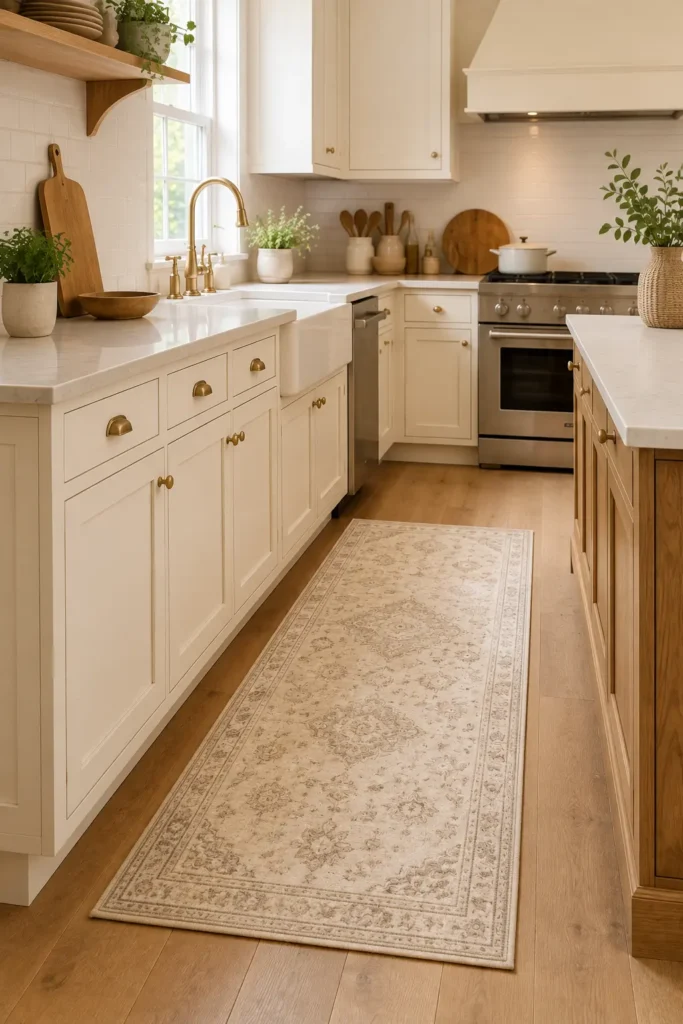
Get the placement right
The runner should support the kitchen’s layout rather than interfere with it.
Make sure:
- cabinet doors can open freely
- appliance doors aren’t blocked
- the rug doesn’t create a tripping hazard
- the main walking path remains comfortable
If your kitchen is narrow, a runner can make the space feel more intentionally designed rather than simply filling an empty strip of floor.
Shopping idea: A neutral washable kitchen runner is one of the most practical pieces to include in a cozy kitchen update.
Bring in Soft Kitchen Textiles
Textiles are an easy way to make a kitchen feel less hard and utilitarian.
You don’t need many.
One or two thoughtfully chosen pieces can be enough.
Consider:
- linen or cotton kitchen towels
- a simple seat cushion
- a small woven basket
- a soft table runner
- neutral fabric curtains where appropriate
Natural-looking textures usually work especially well with cozy kitchens because they add visual softness without making the room feel overly decorated.
Keep the colors connected to the rest of the room.
If your kitchen has warm white cabinets and natural wood, cream, beige, taupe, or muted earthy textiles will usually feel more cohesive than introducing several unrelated bright colors.
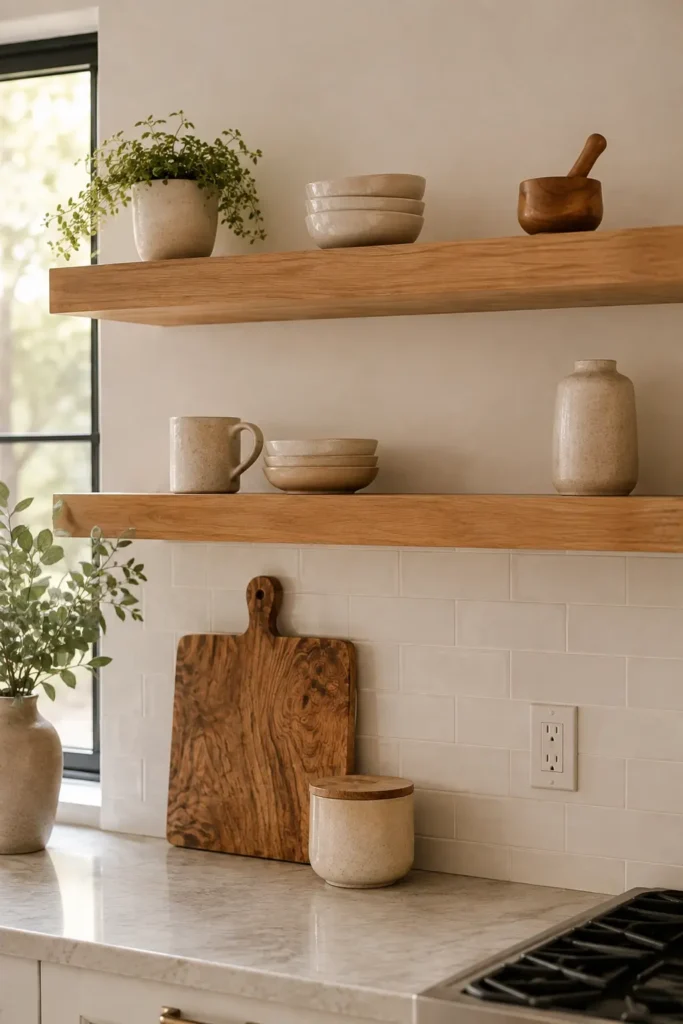
Style Open Shelves Without Making Them Look Cluttered
Open shelving can make a kitchen feel warm and personal, but it can also become one of the fastest ways to create visual clutter.
The secret is editing.
Instead of filling every shelf, choose a small mix of:
- everyday ceramics
- bowls
- mugs
- cookbooks
- a small plant
- one wooden object
- a piece of pottery or artwork
Leave some empty space between groups.
Create small visual groupings
For example:
Stack of bowls + small plant
or
Two mugs + ceramic vase
or
Cookbooks + wooden object
This gives the eye somewhere to rest.
You don’t need every item to match.
In fact, a few variations in shape and texture often make shelves feel more collected.
One useful rule
If everything is decorative, nothing feels special.
Mix useful objects with decorative ones.
That is what makes a kitchen feel like a real home.
Make Your Countertops Feel Warm and Intentional
Countertops are one of the easiest places to accidentally create clutter.
A coffee machine, toaster, oils, utensils, cutting boards, containers, appliances, mail, and random objects can quickly compete for attention.
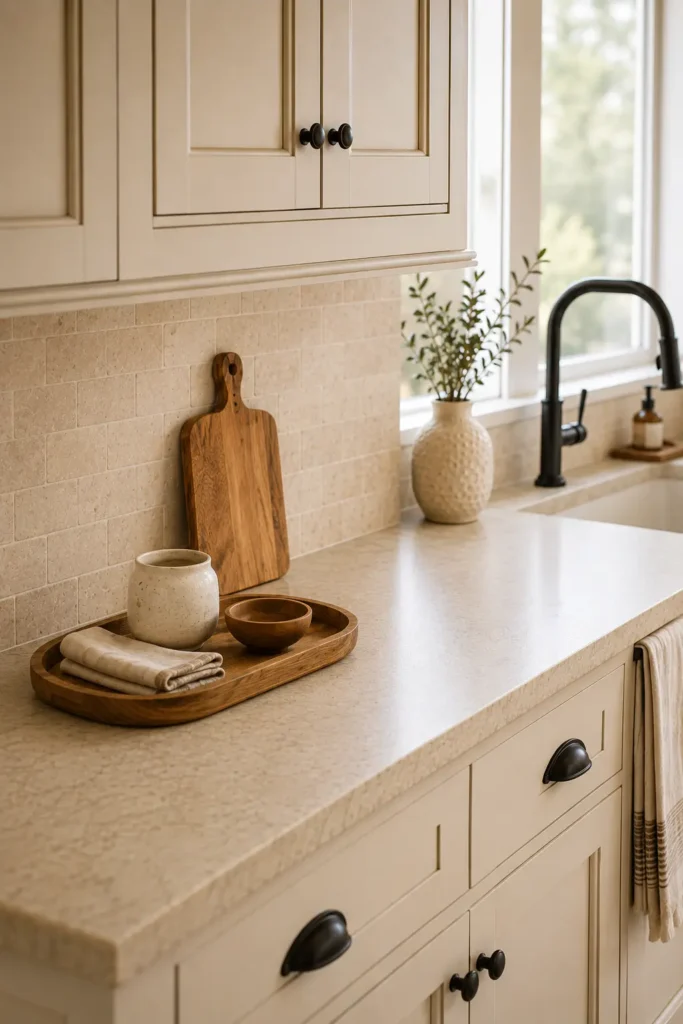
Instead of trying to decorate the entire countertop, create small intentional zones.
For example:
A cooking zone
A wooden cutting board + olive oil bottle + small utensil container.
A coffee zone
Coffee maker + mugs + small tray.
A greenery zone
Herb planter + small vase.
The rest of the countertop can remain relatively clear.
Use trays as visual boundaries
A wooden tray can be particularly useful because it groups several small objects into one visual unit.
Instead of seeing:
mug + jar + spoon + plant + sugar container
the eye sees:
one coffee station.
This simple trick can make a kitchen feel more organized without requiring additional storage.
Shopping idea: Look for a simple natural-wood countertop tray with a finish that complements your existing kitchen.
Bring Greenery and Fresh Herbs Into the Kitchen
Plants are one of the easiest ways to make a kitchen feel alive.
You don’t need a large collection.
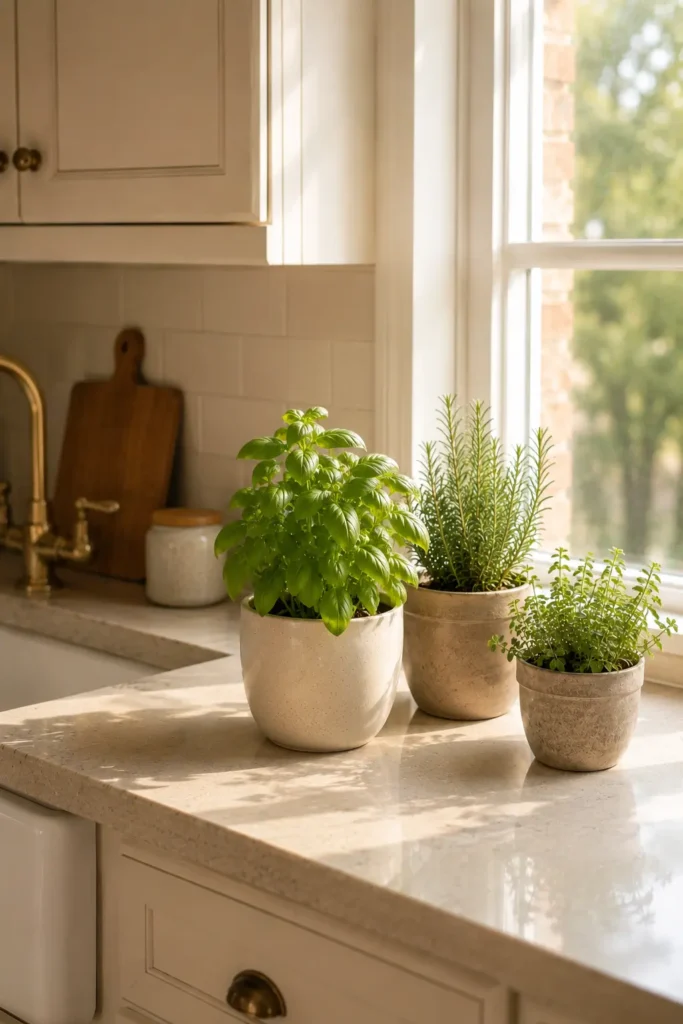
A small herb planter near a bright window can be enough.
Try:
- basil
- rosemary
- mint
- thyme
- parsley
If your kitchen doesn’t get enough natural light for herbs, choose a small low-maintenance plant instead.
You can also introduce greenery through:
- a tiny vase of flowers
- a trailing plant on a shelf
- one potted plant near the sink
- seasonal branches
The key is scale.
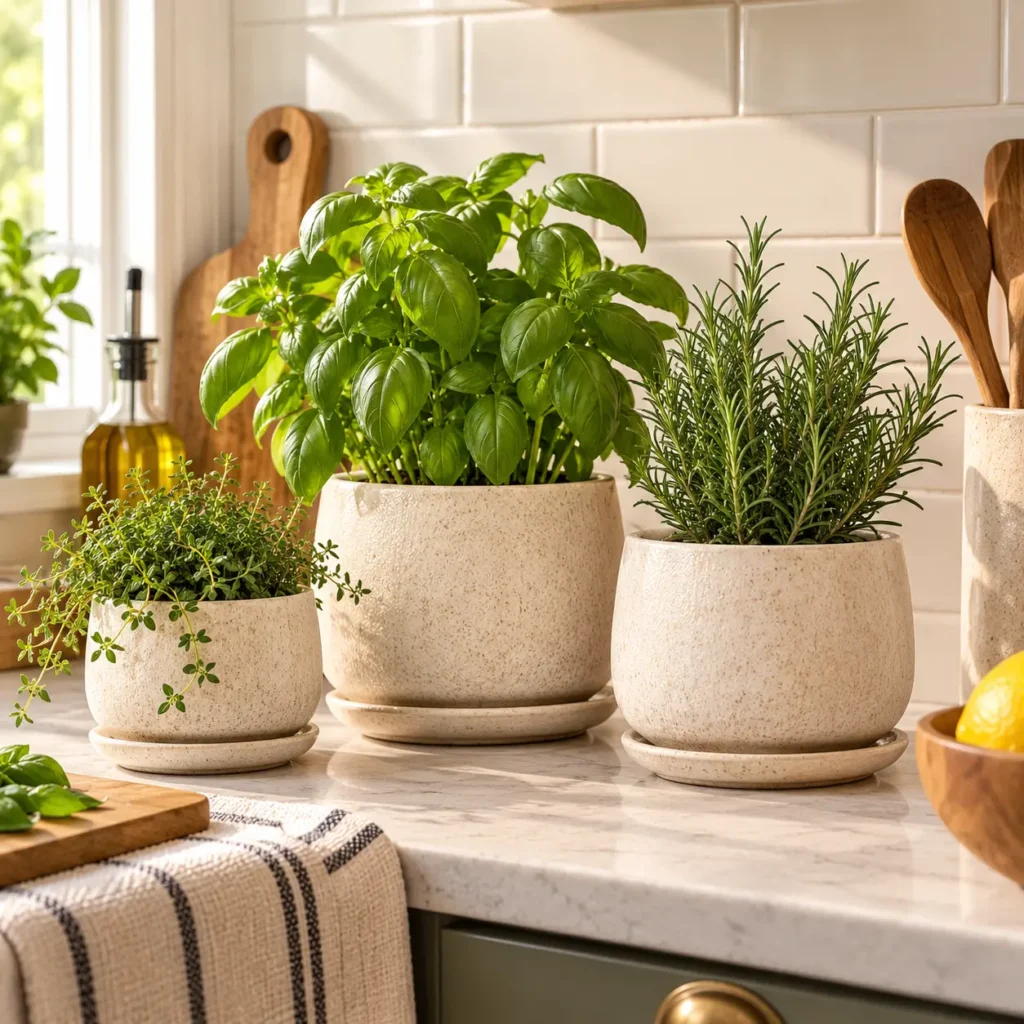
Ceramic Plant Pots — Set of 3
A set of three ceramic plant pots in different sizes, each with a matching saucer. The neutral reactive-glaze beige finish adds a soft, natural touch to kitchen counters and works especially well for grouping herbs or small plants.
A small kitchen doesn’t need five large plants.
One or two thoughtfully positioned pieces often have more impact.
Create a Cozy Coffee or Breakfast Corner
A kitchen starts feeling especially inviting when it supports more than cooking.
If you have even a small amount of extra space, create a dedicated corner for something you genuinely enjoy.
That could be:
- morning coffee
- breakfast
- reading
- conversation
- baking
- tea
A simple coffee station
You don’t need an elaborate built-in cabinet.
Try:
Coffee maker + mugs + small tray + favorite coffee accessories
Keep the arrangement compact and intentional.
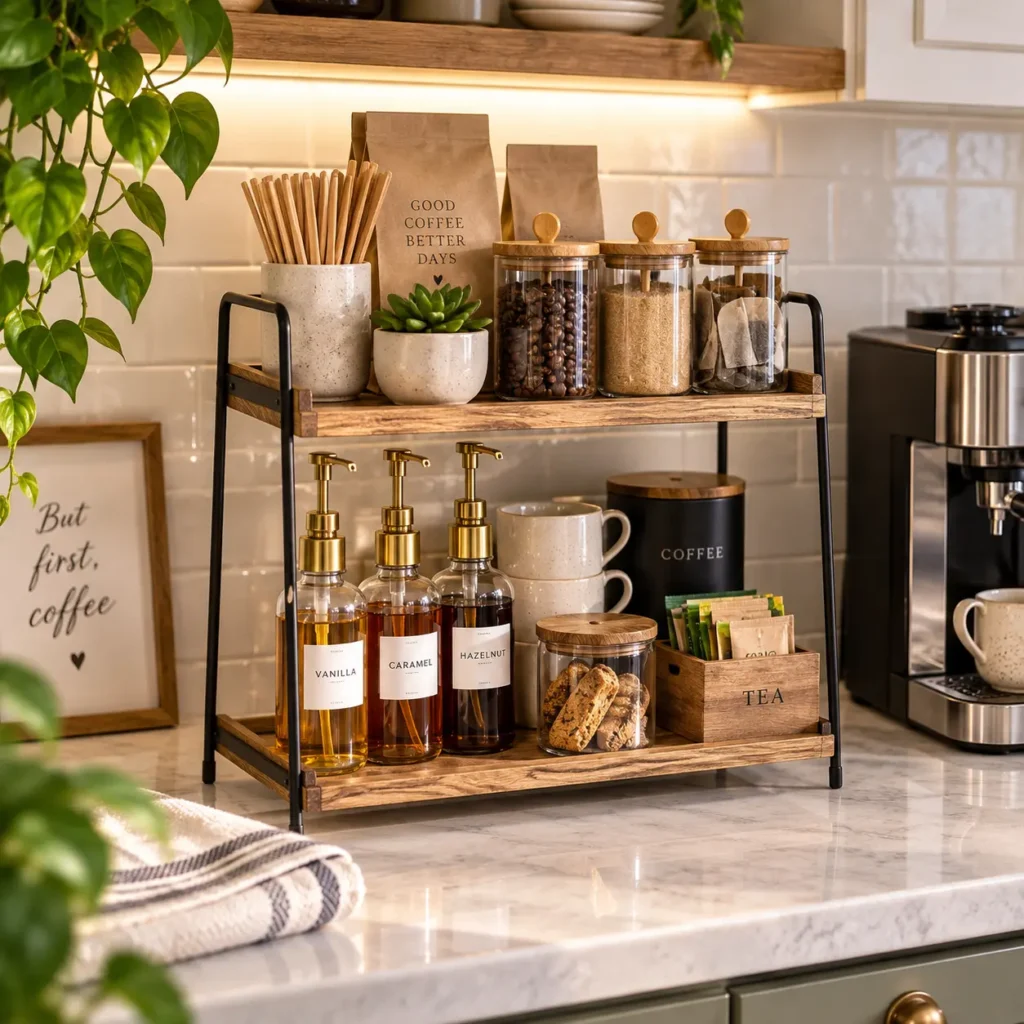
2-Tier Wooden Coffee Station Organizer
A two-tier wooden countertop organizer designed to keep coffee and drink-station essentials neatly arranged. Its warm wood finish and open shelving also add a decorative touch to a cozy kitchen corner.
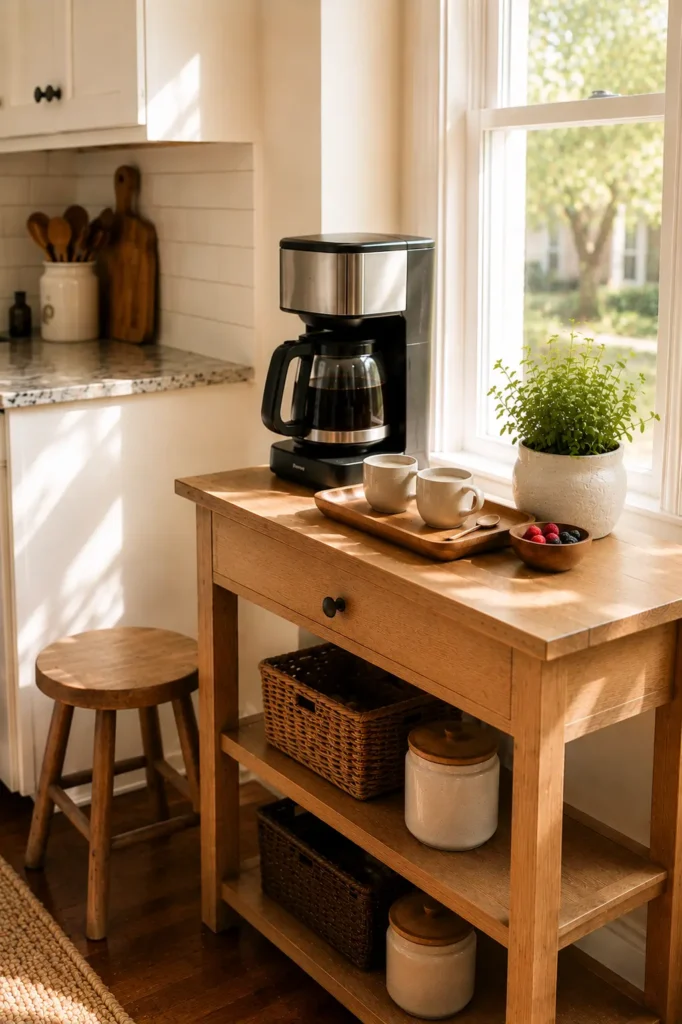
A small breakfast corner
If space allows, a small table with two comfortable chairs can turn an unused corner into one of the most useful parts of the kitchen.
And if your kitchen is very small, a narrow counter, wall-mounted surface, or compact rolling cart can sometimes serve the same purpose.
The important thing is to design around how you actually live.
A kitchen designed only for cooking can feel purely functional.
A kitchen that gives you somewhere to pause for five minutes over coffee can feel much more like part of the home.
Add Personality With Art and Vintage Details
One reason some kitchens feel cold is that everything looks new, coordinated, and interchangeable.
A little personality changes that.
Try adding:
- framed artwork
- vintage kitchen pieces
- favorite cookbooks
- handmade ceramics
- family objects
- thrifted finds
- a small framed print
- an interesting bowl or vase
You don’t need a vintage-style kitchen to use vintage objects.
A contemporary kitchen can become much warmer with one old wooden board, a framed botanical print, or a handmade ceramic bowl.
The same idea of adding personality without creating visual clutter can work in other small spaces too, such as a cozy TV corner.
Let the kitchen tell a little story
For example, the cookbook might be one you actually use.
Perhaps the ceramic bowl came home with you from a trip.
An artwork piece might remind you of somewhere you love.
Those details are often what make a room feel personal.
Make Storage Part of the Decor
Storage doesn’t have to disappear completely.
Some of the most attractive kitchen storage solutions can become part of the room’s visual character.
Try:
- woven baskets
- wooden boxes
- ceramic containers
- attractive jars
- open shelves
- wall hooks
- countertop trays
- vertical organizers
The important thing is to distinguish between display storage and hidden storage.
Things you use frequently and that look attractive can remain visible.
Things that create visual noise can be stored away.
This is especially important in small kitchens, where every surface tends to become a storage area.
Think in zones
Instead of asking:
“Where can I put this?”
ask:
“Where should this category of things live?”
Coffee items together.
Cooking oils together.
Baking supplies together.
Everyday mugs together.
That simple shift makes the kitchen easier to use and usually makes it look calmer too.
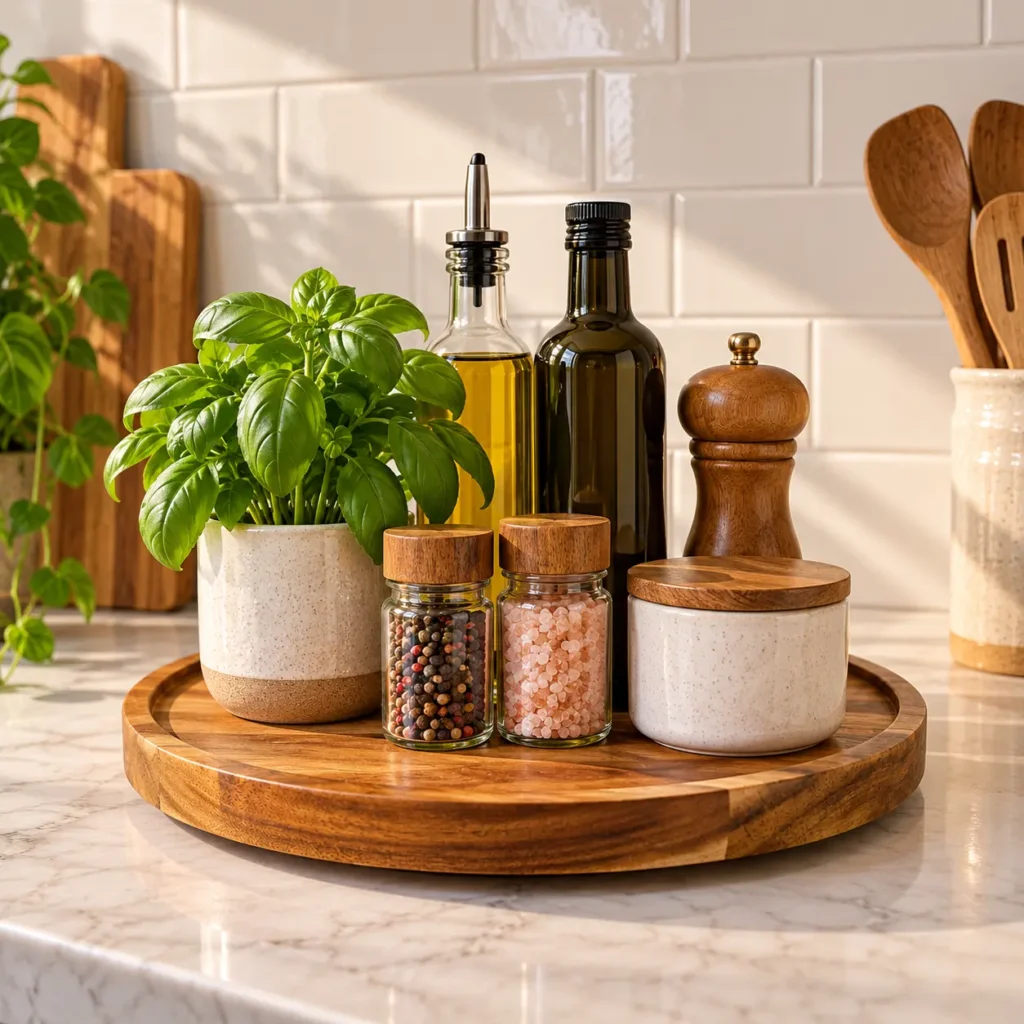
Acacia Wood Lazy Susan Organizer
A round acacia wood organizer that adds natural warmth while keeping frequently used kitchen essentials together. Its 10-inch size makes it suitable for organizing items on a countertop, table, or inside a pantry cabinet.
Want to Recreate the Cozy Kitchen Look?
I’ve gathered the kitchen-friendly pieces featured in this guide in one curated Amazon storefront, so you can browse everything in one place.
Design Your Kitchen Around How You Actually Use It
This might be the most important cozy-kitchen idea of all.
A beautiful kitchen that doesn’t support your routine won’t feel comfortable for long.
Think about what happens in your kitchen every day.
If you drink coffee every morning
Create a small coffee zone so everything you need is together.
If you cook frequently
Keep your main preparation area clear and prioritize useful task lighting.
If your family gathers in the kitchen
Comfortable seating may matter more than additional decorative objects.
If you entertain
Create an easy serving area where drinks or food can be placed without blocking your main work surface.
If storage is your biggest problem
Use vertical space before adding more countertop storage.
If you mostly use the kitchen at night
Invest more attention in warm layered lighting.
The best kitchen design isn’t necessarily the one that looks most impressive in a photograph.
It’s the one that makes your everyday routine easier while still making you happy to be there.
Cozy Kitchen Ideas for Small Spaces
Small kitchens can absolutely feel cozy.
In fact, their size can sometimes make them feel more intimate.
The challenge is making the room feel warm without making it feel full.
The same principle applies to other compact rooms too—see our cozy living room ideas for small apartments for more ways to create warmth without overwhelming a small space.
1. Use vertical space
When floor and countertop space are limited, look upward.
Depending on your kitchen and whether you’re allowed to make changes, consider:
- open shelves
- wall-mounted rails
- hooks
- tall storage
- narrow shelving
- vertical organizers
Use the vertical space for things that would otherwise occupy your counters.
2. Keep the countertops visually calm
A small kitchen doesn’t have enough visual space for every appliance and decorative object to compete.
Choose a few items worth displaying and store the rest.
3. Choose multifunctional furniture
A small rolling cart can serve as:
- storage
- prep space
- coffee station
- serving surface
A small table can provide both dining and preparation space.
Furniture that performs more than one job is particularly valuable in compact kitchens.
4. Use warm, light colors
Light warm colors can help a small kitchen feel more open without making it feel sterile.
Try:
- cream
- warm white
- pale beige
- light oak
- muted green
Then introduce contrast through small accessories.
5. Scale your decor correctly
A tiny kitchen doesn’t need oversized decorative objects.
Choose:
- small plants
- narrow trays
- compact artwork
- slim runners
- smaller ceramics
One well-proportioned object can look more intentional than several pieces competing for space.
6. Create one focal point
Instead of decorating every wall, choose one area to receive attention.
It could be:
- open shelving
- a coffee corner
- a beautiful backsplash
- a piece of artwork
- a small dining area
This gives the room visual direction.
7. Let the counter breathe
This is perhaps the most important small-kitchen rule:
Empty space is useful space.
Don’t feel obligated to fill it.
A clear section of countertop can make the entire kitchen feel larger and calmer.
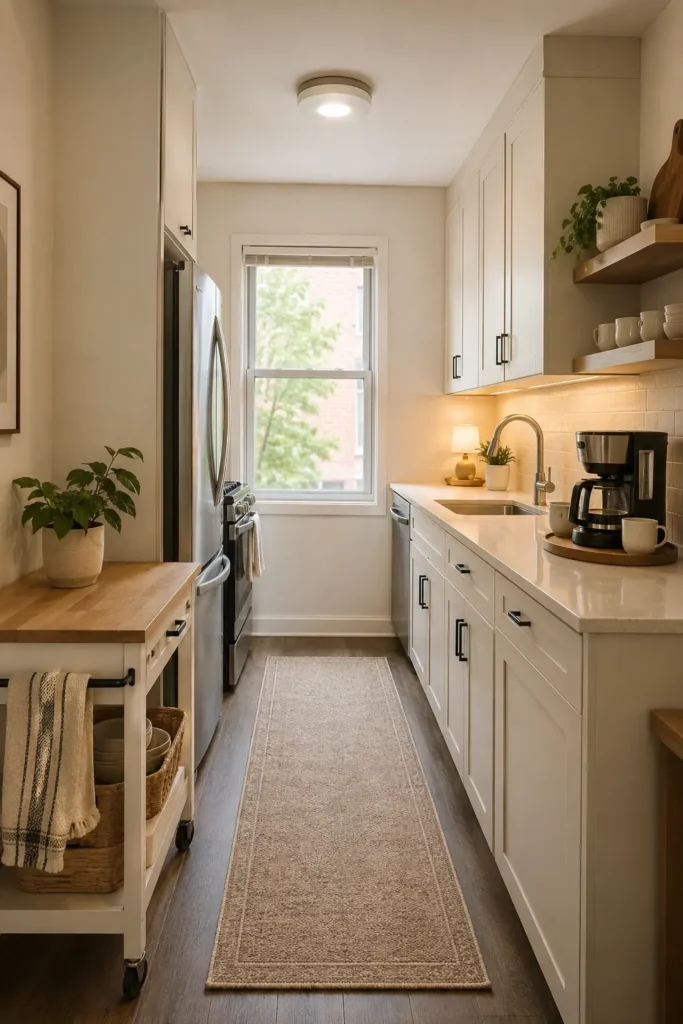
Cozy Kitchen Ideas for Renters
A rental kitchen may come with cabinets, counters, lighting, and finishes you wouldn’t have chosen yourself.
That doesn’t mean you have to live with a kitchen that feels impersonal.
If you’re also working with a small rental balcony, our cozy balcony decor ideas show how the same removable, space-conscious approach can work outdoors.
The safest approach is to focus on changes that are removable, portable, or reversible, and always check your lease before making alterations.
Start with no-install changes
These can include:
- washable runners
- kitchen towels
- countertop trays
- plants
- ceramics
- artwork that can be displayed without permanent installation
- portable storage
- decorative objects
Improve the lighting
If the kitchen has one harsh ceiling light, a rechargeable under-cabinet light can make a noticeable difference without requiring electrical work.
Add removable personality
Depending on your lease and the condition of the surfaces, removable backsplash products, temporary hooks, or other renter-friendly solutions can help.
Always check the manufacturer’s instructions and test adhesives in an inconspicuous area before committing.
Don’t fight the kitchen
If the cabinets are cool white, you don’t necessarily need to disguise them.
Instead, work with them.
Add warmth through:
- wood
- beige
- greenery
- warm lighting
- textiles
That usually looks more cohesive than trying to force the room into a completely different style.
Cozy Kitchen Ideas on a Budget
You don’t need to buy everything at once.
In fact, the best budget approach is to make changes in order of impact.
Under $25
Start with small changes such as:
- kitchen towels
- thrifted ceramics
- small plants
- wooden utensils
- simple artwork
- a small tray
You can also rearrange things you already own.
Sometimes the cheapest improvement is simply removing unnecessary objects.
Around $25–$75
This is where you can consider:
- a washable runner
- a countertop tray
- small lighting upgrades
- a planter
- better storage accessories
Choose products that solve an actual problem rather than buying something simply because it looks good online.
Larger upgrades
If your budget allows, consider:
- comfortable seating
- a small kitchen cart
- improved lighting fixtures
- better storage
- a small dining table
But don’t feel pressured to complete everything at once.
A cozy kitchen can be built gradually.
A simple budget strategy
If you’re starting from scratch, prioritize:
1. Lighting
2. Floor/textiles
3. Natural materials
4. Greenery
5. Organization
6. Personality
That order gives you a strong foundation before you spend money on purely decorative pieces.
Choose a Cozy Kitchen Style That Fits Your Home
Cozy doesn’t belong to one decorating style.
You can create warmth within almost any aesthetic.
Cozy Modern Kitchen
Use:
- clean lines
- warm white
- natural wood
- soft lighting
- simple ceramics
Keep the decor restrained.
Cozy Cottage Kitchen
Think:
- creamy colors
- vintage ceramics
- natural wood
- floral or botanical details
- soft textiles
- open shelving
The goal is charming rather than overly themed.
Cozy Farmhouse Kitchen
Use:
- natural wood
- simple ceramics
- woven textures
- neutral colors
- practical storage
- comfortable seating
Avoid filling the room with obvious farmhouse signs or overly matching accessories.
Cozy Scandinavian Kitchen
Focus on:
- light wood
- warm whites
- simple forms
- natural textures
- restrained decoration
This style works especially well in smaller spaces.
Warm Minimalist Kitchen
Use fewer objects, but make each one count.
Think:
cream + wood + soft lighting + one plant + a few beautiful functional objects.
Minimalism doesn’t have to feel cold. If you enjoy this restrained approach beyond the kitchen, you can also explore these aesthetic room ideas for more budget-friendly ways to create a polished look.
The secret is adding enough warmth and texture to prevent the room from becoming visually sterile.
Cozy Kitchen Mistakes to Avoid
Sometimes creating a cozy kitchen is less about adding things and more about removing the wrong things.
1. Relying only on harsh overhead lighting
A bright ceiling light may be useful while cleaning or cooking, but it shouldn’t have to do everything.
Add lower, warmer sources where possible.
2. Making everything cool white
Cool white can look clean, but too much of it can make a kitchen feel clinical.
Balance it with:
- wood
- warm lighting
- beige
- cream
- greenery
- textiles
3. Decorating every countertop
More decor doesn’t automatically mean more cozy.
Leave functional breathing room.
4. Using too many competing textures
Wood + wicker + rattan + marble + patterned tile + several fabrics can quickly become visually noisy.
Choose a few materials and repeat them.
5. Choosing furniture that is too large
This is particularly damaging in small kitchens.
Measure first.
A beautiful chair that blocks a walkway isn’t a successful design choice.
6. Ignoring how people move through the kitchen
Cabinet doors, refrigerator doors, dishwasher doors, and major walking paths need clearance.
Decor should work around the kitchen’s function.
7. Copying a photograph exactly
A Pinterest or magazine kitchen may be beautiful, but your home, budget, lighting, storage needs, and lifestyle are different.
Use inspiration as a starting point.
Don’t try to reproduce somebody else’s kitchen piece by piece.
8. Confusing cozy with cluttered
This is the biggest one.
A cozy kitchen has:
- warmth
- texture
- personality
- useful objects
- visual balance
A cluttered kitchen simply has too much competing for attention.
Frequently Asked Questions About Cozy Kitchen Ideas
A cozy kitchen usually combines warm lighting, natural materials, soft textures, greenery, and a welcoming color palette. Simple additions such as a warm lamp, wooden accents, a kitchen runner, fresh herbs, or ceramic pieces can make the space feel more inviting without making it cluttered.
You don’t need to renovate your kitchen to make it feel cozy. Start with what you already have, then add affordable touches such as soft kitchen towels, a small runner, wooden cutting boards, plants or herbs, ceramic pieces, and warm lighting. Rearranging your countertops and creating simple decorative zones can also make a noticeable difference.
Focus on adding warmth without sacrificing useful workspace. Use vertical storage, multifunctional furniture, compact organizers, a small amount of greenery, and carefully chosen decorative pieces. Keeping countertops relatively clear can help a small kitchen feel comfortable and organized rather than crowded.
Warm whites, cream, beige, soft greige, muted greens, earthy browns, and other natural tones can create a welcoming kitchen atmosphere. You can also introduce warmth through natural wood, woven materials, brass or aged-metal details, and warm-colored textiles instead of relying only on wall or cabinet color.
The key is to decorate selectively. Choose a few useful items that also look attractive, group small objects on trays, keep frequently used items accessible, and leave some open countertop space. Cozy design works best when warmth, personality, and organization are balanced.
Layered lighting works especially well in kitchens. Combine general room lighting with task lighting under cabinets and softer accent lighting where possible. A small countertop lamp or decorative fixture can add another warm layer, while dimmable lighting allows you to adjust the atmosphere throughout the day.
Focus on removable and portable changes such as kitchen runners, countertop organizers, plants, artwork that does not require permanent installation, decorative lighting, textiles, and freestanding storage. These additions can bring personality and warmth while keeping the space easy to change when you move.
Create small intentional zones rather than decorating every available surface. A wooden tray can group everyday items, while a cutting board, ceramic container, small plant, or coffee station can add visual interest. Keep a clear working area and remove anything that does not serve a practical or decorative purpose.
Natural wood is one of the easiest ways to introduce warmth and texture. Wooden cutting boards, trays, stools, shelves, and other small accents can soften kitchens with white, gray, or neutral finishes. Plants, woven baskets, ceramic pieces, and natural textiles can reinforce the same feeling.
Common mistakes include adding too many decorative objects, blocking useful counter space, choosing lighting that feels too harsh, using furniture that is too large, and buying decor before considering how the kitchen is actually used. A smaller number of well-chosen pieces usually creates a more comfortable and intentional result.